July 30, 2026
On a rocky stretch of East Antarctica, where katabatic winds—fierce winds driven by cold, dense air cascading from the continent’s icy plateau—can exceed hurricane force and winter darkness lasts for months, a group of scientists, engineers, architects, and policy experts are reimagining Antarctic research stations.
Their vision: a low-impact international research hub powered almost entirely by renewable energy.
The proposed Andromeda Earth Observatory (AEO), announced and discussed in depth at the 2026 Antarctic Futures Symposium in Luxembourg, would support activities ranging from glaciology and atmospheric science to biodiversity surveys, satellite communications, engineering research, and space analogue testing.
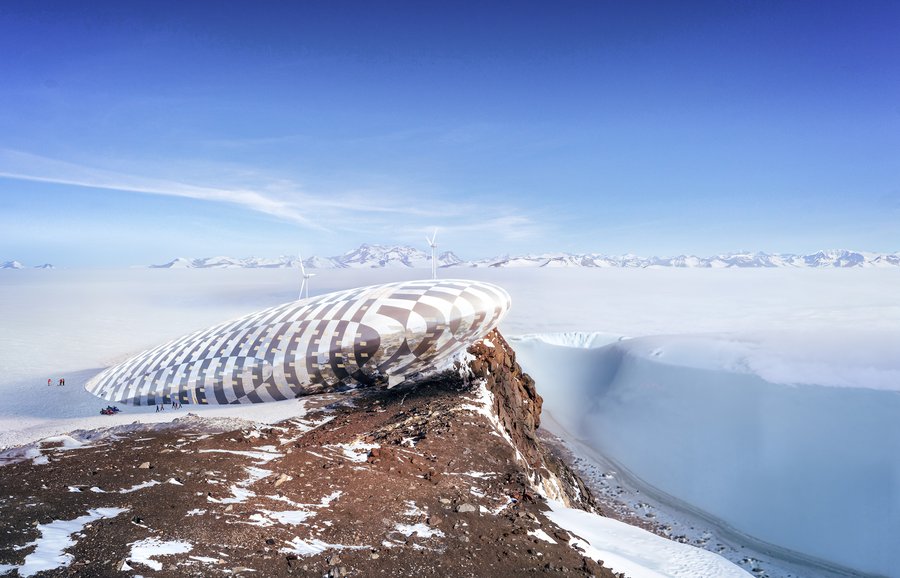
Rendering of the proposed Andromeda Earth Observatory. (Designed by © SAMYN and PARTNERS Architects & Engineers)
The project’s ambitions extend beyond science alone. Its backers argue that Antarctica offers one of the clearest testing grounds for a larger question: how humans might build infrastructure in extreme environments without reproducing the same extractive systems that have defined much of modern development elsewhere.
“What we’re hoping to build is a genuine link between different scientific disciplines, and between science and space activities,” said Nighat Amin, co-founder of the International Polar Foundation (IPF) and one of the project’s leading voices. “Reading the earth is, at its core, observing it.”
The distinction matters, as project members repeatedly refrain from describing Andromeda as a “station.”
“All science begins with observation,” Amin said. “Calling something a station doesn’t do justice to the science. A station is where you wait for a train.”
This observatory builds on lessons learned from Princess Elisabeth Antarctica, IPF’s existing research station in Queen Maud Land, often described as the world’s first zero-emission polar research station. Andromeda, however, is envisioned at a far larger scale and with broader scientific capabilities.
According to Laurent Pfister, Head of the Environmental Sensing and Modelling Research Unit at the Luxembourg Institute of Science and Technology (LIST), the project is being designed around “total operational autonomy.”
“The station will run entirely on renewable energy, e.g., wind and solar, backed by high-end storage systems engineered to guarantee uninterrupted power availability around the clock, even under the most extreme Antarctic conditions,” Pfister said.
The observatory’s proposed infrastructure includes closed-loop water and waste systems, hydroponic agriculture, smart-grid energy management, and low-carbon data centres whose waste heat would be redirected to warm living quarters and greenhouses. Rather than treating wastewater or excess heat as disposal problems, the design attempts to reincorporate them into the station itself.
“The principle is straightforward,” Amin said. “There is always a use for something.”
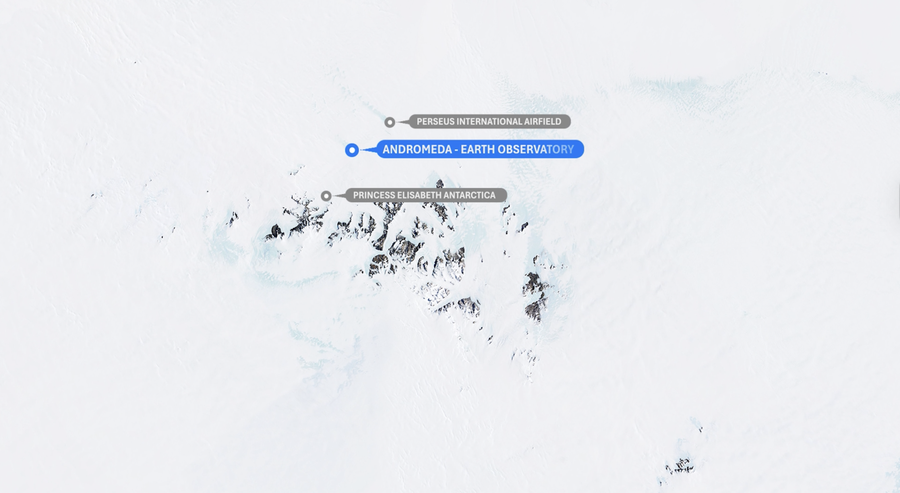
This observatory builds on lessons learned from Princess Elisabeth Antarctica, IPF’s existing research station in Queen Maud Land. (Designed by © SAMYN and PARTNERS Architects & Engineers)
For scientists working in Antarctica, the appeal lies not only in the engineering challenge but also in the observational gaps the facility could help address.
Eric Rignot, a glaciologist at the University of California, Irvine, notes that East Antarctica remains significantly under-observed despite its global importance.
“AEO will be a platform for scientists to access observations that are totally novel,” Rignot said. Adding that it would provide access to previously largely unstudied biodiversity—from microbes to top predators across land and ocean. This would include ice-shelf cavities that influence sea-level rise, and ancient blue ice fields that preserve millions of years of unknown climate history.
Those gaps are not simply academic. East Antarctica contains enough ice to raise global sea levels dramatically if destabilized, yet researchers still lack consistent long-term measurements across large portions of the continent.
“We cannot model what we cannot observe,” Rignot said. “Imagine having to forecast weather in the US without observations of the weather. Impossible.”
While satellites have transformed Antarctic science over the last several decades, many researchers say there remains a critical shortage of year-round ground observations, particularly in remote regions. According to Rignot, the observatory could help support more continuous monitoring of ocean conditions, atmospheric circulation, ice shelf cavities, biodiversity, and surface mass balance.
The project also arrives during a moment of growing geopolitical and scientific tension in Antarctica. Although the Antarctic Treaty System formally designates the continent for peace and science, participation in Antarctic research infrastructure remains uneven. Only a relatively small number of countries operate permanent stations, and international collaboration at the infrastructure level has historically been limited.
“One of the key stated objectives of the Antarctic Treaty is to encourage collaborative international research,” Amin said. “And yet, in over sixty years, there is only one joint facility between two countries: Concordia, run by France and Italy.”
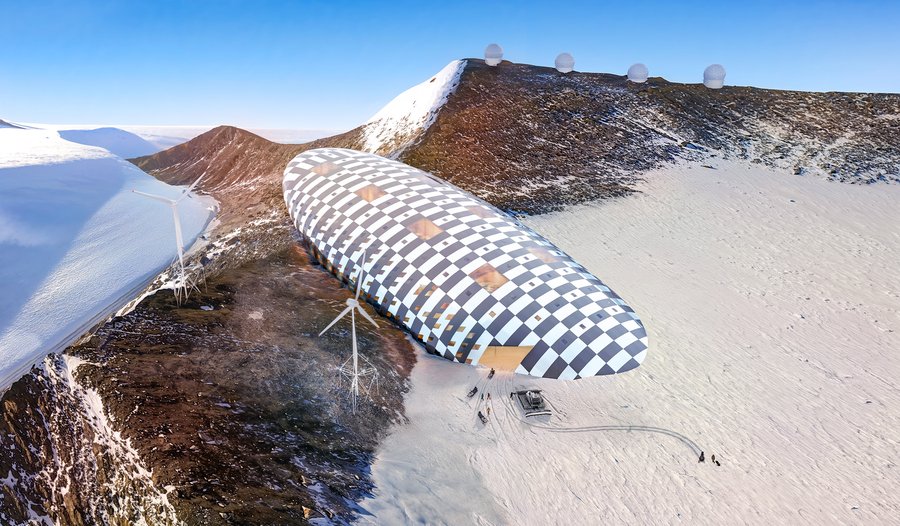
Rendering of the proposed Andromeda Earth Observatory. (Designed by © SAMYN and PARTNERS Architects & Engineers)
The Andromeda team argues the observatory could offer access to countries and institutions that currently lack a physical foothold in Antarctica.
“Scientists and engineers from countries and universities that currently lack their own Antarctic infrastructure will have a genuine home base on the continent,” Pfister said.
The project also proposes something rarely emphasized in discussions about Antarctic infrastructure: livability. Historically, overwintering in Antarctica has been physically and psychologically difficult, and many stations remain heavily dependent on fossil fuel systems and repeated logistical resupply. Amin stated that Andromeda is being designed with the recognition that retaining skilled personnel in isolated environments is becoming increasingly difficult.
“We can make it something more than an outpost,” she said. “Not a place to suffer, as overwintering has traditionally been.”
Still, major uncertainties remain. The observatory has not yet been built, and the project team is currently focused on fundraising and consolidating long-term international operational partnerships. Hydrogen storage and zero-emission mobility systems remain technological hurdles, according to Rignot, while Antarctic geopolitics continues to complicate large multinational initiatives.
“There is pushback,” Amin acknowledged, pointing to concerns from some Antarctic Treaty nations over infrastructure development within territorial claims. The broader challenge may be whether Antarctica, a continent often described as a laboratory for international cooperation, is truly prepared for a different model of collaboration.
Whether Andromeda ultimately becomes a blueprint for the future of polar research or remains an ambitious concept will depend on funding, politics, and technology still in development.
If successful, the project’s supporters believe the observatory could become not only a new research platform but a test case for how humans might inhabit extreme environments more carefully in the future.
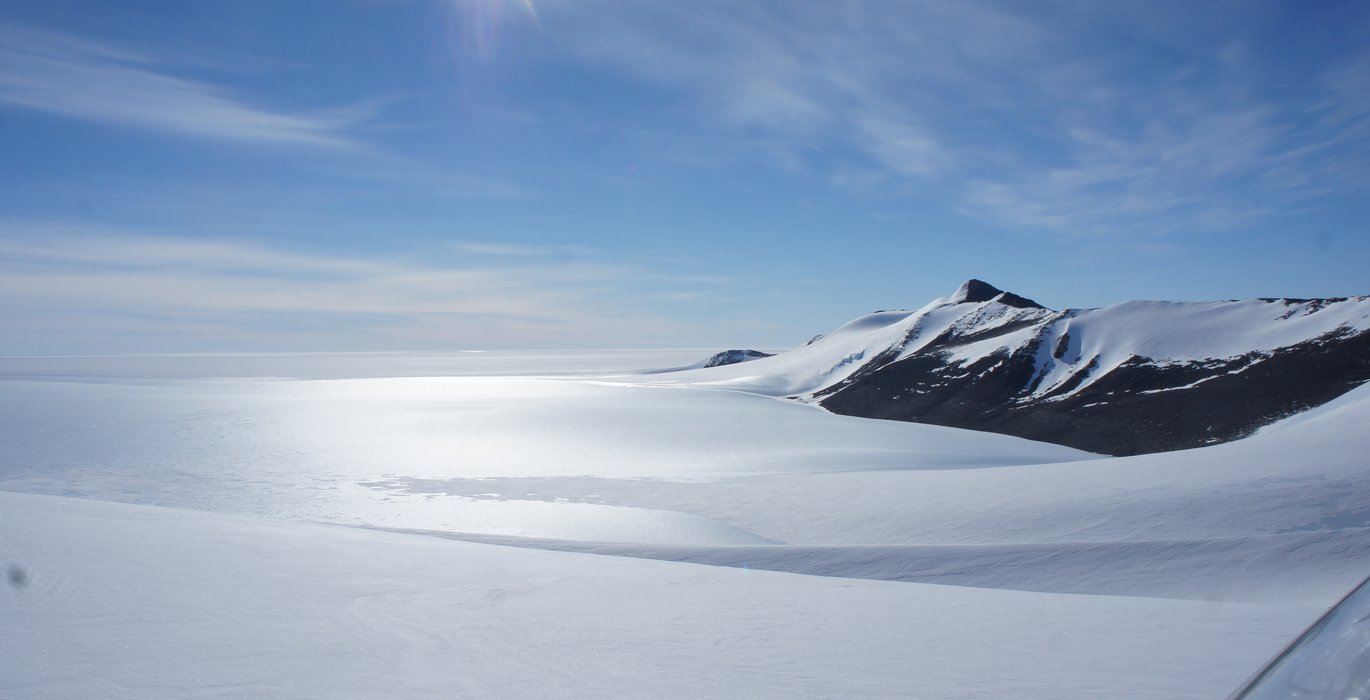
Banner Image Caption: A photo of Vesthaugen Nunatak in the Queen Maud Land, East Antarctica, where the station will be built. © International Polar Foundation.