May 07, 2026
The fifth edition of the Arctic Science to Art (AS2A) contest returns in May 2026, inviting early-career scientists working in Canada’s North to transform their research into art that connects knowledge back to the communities who help shape it.
Hosted by the Association of Polar Early Career Scientists (APECS) Canada in partnership with ArcticNet, Centre for Northern Studies (CEN), and Arctic Research Foundation (ARF), the contest continues its mission to connect Arctic research with creative expression.
According to Nathaniel Holloway, a graduate student at the University of Ottawa and one of the organizers of AS2A, the contest’s goal is to maximize the impact of research and how it can be used to better society.
“Science doesn’t have to be so bland. It can create a specific dialogue and bridge the connection between research and community,” said Holloway.
Last year’s contest received 29 applications from independent scientists and those affiliated with Canadian universities. A panel of judges selected the winner, who was then paired with a Northern artist to create a plain-language comic strip for distribution.
“We not only want the results to be available and accessible. We want the delivery to be enjoyable to those who read it,” said Holloway.
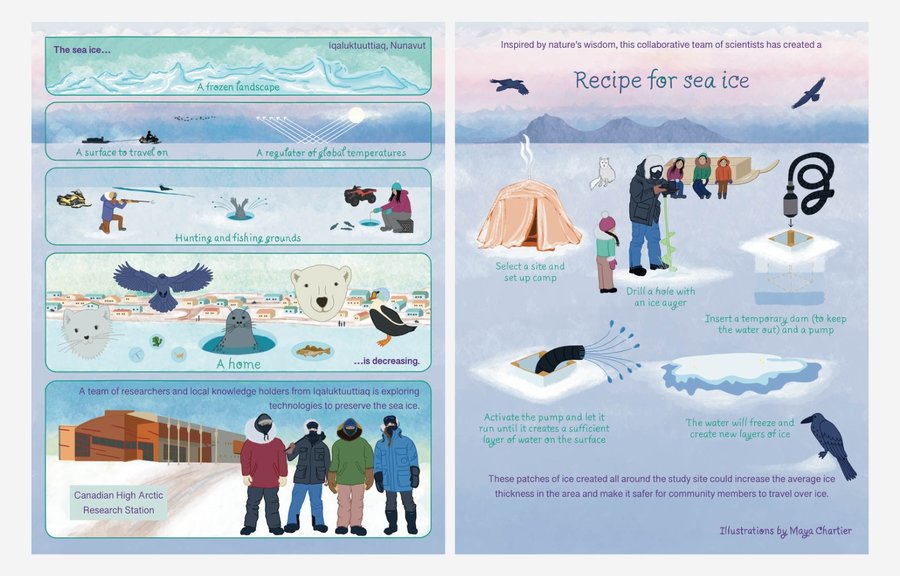
AS2A contest aims to maximize the impact of research and how it can be used to better society. (Credit: AS2A/ APECS Canada)
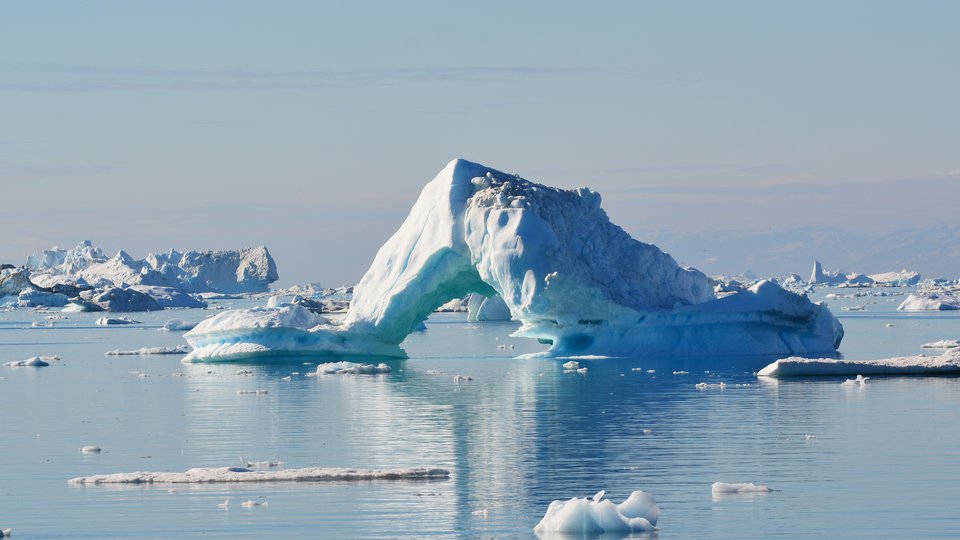
Konrad Borowski, the 2026 AS2A winner, is a Master’s student at the University of Waterloo studying the current state of Arctic sea ice. Specializing in biomimicry, he’s also a researcher for Real Ice, which explores ways to extend the longevity of ice shelves in the North and examines their impacts on climate change.
“Concrete visuals are critical for communicating scientific work,” Borowski said. “Contests like this create a real pathway towards communicating science in a way that is more accessible to a wide audience.”
Borowski noted that research is often poorly communicated, getting bogged down in jargon that makes critical findings difficult for the public to understand. By pairing researchers with artists, AS2A’s approach makes complex ideas more approachable to a wider audience by communicating findings through comic strips
“Art is a language without borders or pre-requisite classes,” Borowski said. “Having this research so beautifully translated has been a great tool for informing stakeholders and people of all ages about the work I do.”
The comic strip will present visual images of Borowski’s work, exploring ways to strengthen sea ice in the Iqaluktuuttiaq (Cambridge Bay) region of Nunavut. The goal is to use biomimicry to extend the lifespan of Arctic sea ice using saline seawater.
Borowski collaborated with Maya Marieve Chartier, a francophone artist from Whitehorse, Yukon, to create the comic strip. Chartier has experience across a variety of creative mediums, including digital art, sewing, and watercolour. Also a wildlife technician, she was especially excited to explore a subject close to her heart: life in the North.
“I love working on scientific illustrations,” Chartier said. “There is a power in communicating science through art, and it communicates well.”
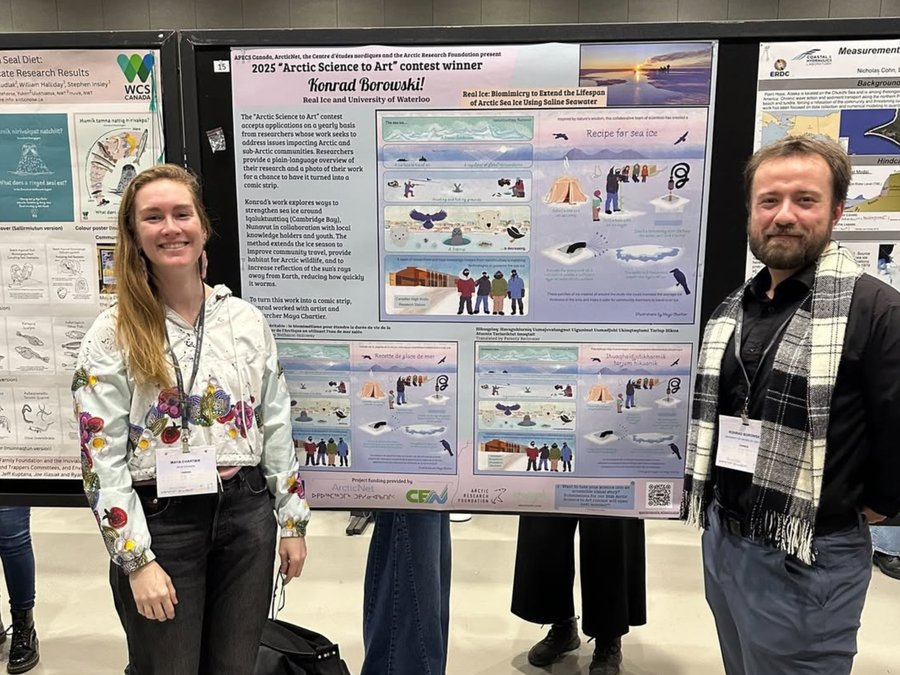
Borowski collaborated and Maya Marieve Chartier presenting the comic strip at ArcticNet ASM 2025 poster session. (Credit: AS2A/ APECS Canada)
The poster was created in three languages (Inuktitut, French and English), and designed to be shared digitally, helping to make the findings more accessible and relevant while extending its reach to remote communities.
“Science has to reach a wide audience to be useful,” Chartier said. “Art helps make it accessible and fun to learn about.”
Chartier and Borowski worked closely to shape how the project would be communicated, considering the layout, visuals, colours, and language to keep the information clear and accessible.
They hope this approach will encourage dialogue around solutions in a rapidly changing environment, spark new ideas and help people of all ages better understand the issues and opportunities ahead.
They are pleased with the final product, noting that the real artistry lies in how the work is presented — how it captures attention and engages people who may not typically connect with art or science.
Chartier is excited to bring knowledge back to the communities most connected to the work. support Northern autonomy and self-governance and inspire others to learn more or get involved.
“I’m proud my artwork can be useful,” Chartier said. “I feel a lot of gratitude, and I’m excited the comic strip will be seen on billboards and in the field.”
To find out more about APECS Canada and the work they’re doing in the North, check out the link: https://apecscanada.wixsite.com/ehpecs.