July 9, 2026
The Beaufort Gyre is a vast, wind-driven current system in the Arctic Ocean that acts as a natural freshwater reservoir. Located north of Alaska and Canada, it plays a crucial role in regulating sea ice, ocean circulation, and climate patterns both locally and globally. It is often regarded as a control switch because shifts in its behaviour can influence weather, ocean currents, and climate systems far beyond the Arctic, highlighting the interconnected nature of Earth’s oceans.
Ocean currents are rivers of warm and cold water that move heat around the globe in a cycle, delivering marine nutrients and regulating our climate and weather. They are driven by wind, the earth’s rotation, and the cycle of temperature and salinity, known as thermohaline circulation.
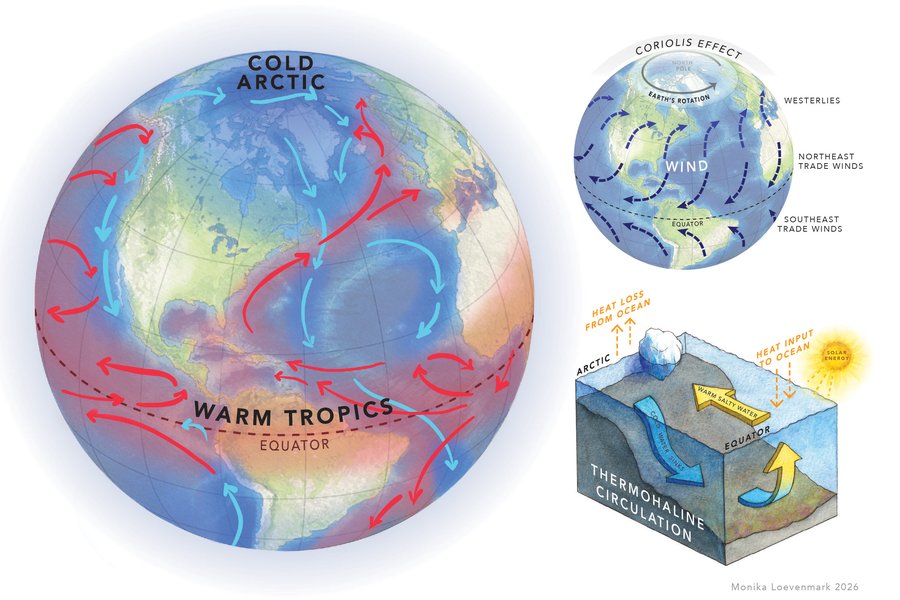
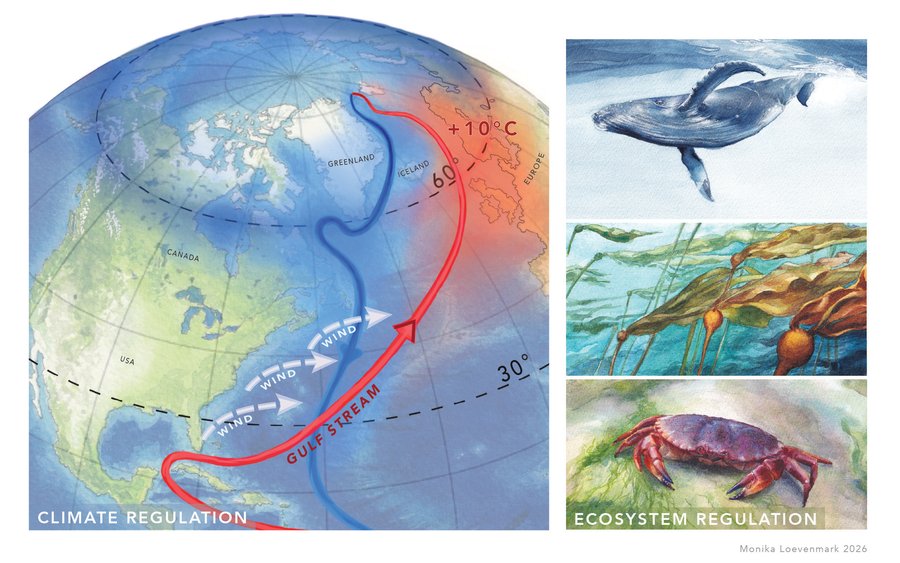
They regulate climate by bringing heat to latitudes that would otherwise be significantly colder. They also distribute temperature and nutrients in the ocean, regulating marine ecosystems.
A key ocean system: the Beaufort Gyre in the Arctic
The polar regions, where cold, dense water forms, play a critical role in driving global ocean circulation. The Beaufort Gyre in the Arctic Ocean is a key part of this system, acting as a reservoir that stores freshwater, penning in sea ice and freshwater by the rotation of the current.
It is driven by a high-pressure system called the Beaufort High, which forms over the Arctic Ocean due to cold Arctic air generated by sea ice. If it weakens and releases the freshwater, as some climate models predict, this will have huge impacts on the salinity stratification that drives another key ocean system, the Atlantic Meridional Overturning Circulation (AMOC).
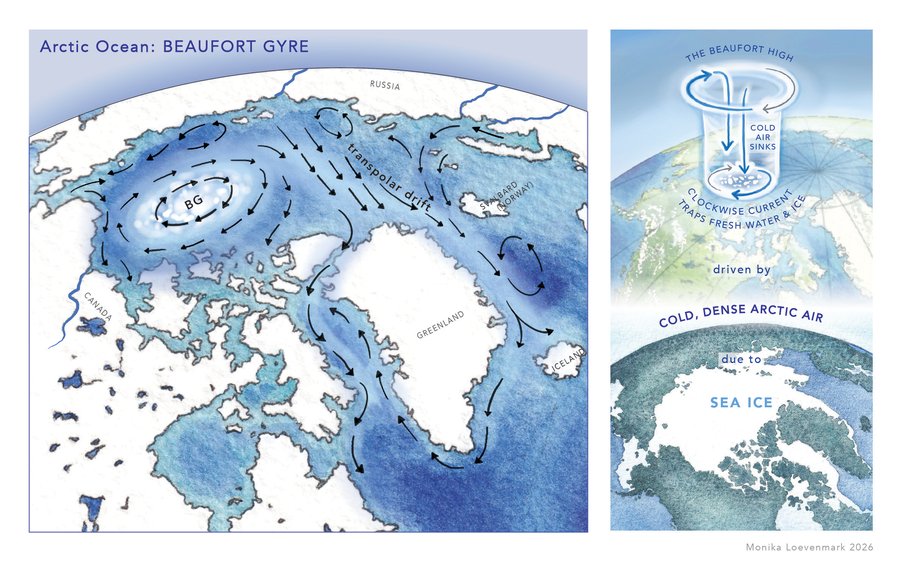
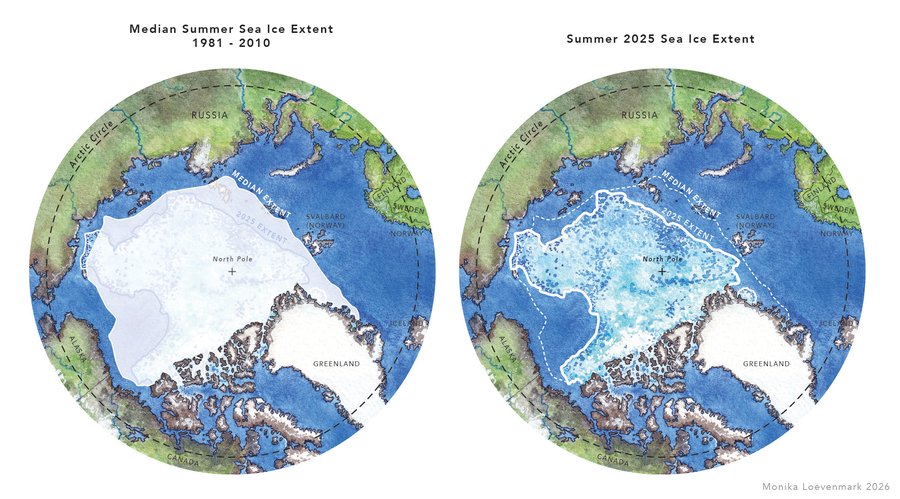
As the planet warms, climate models show that a reduction in sea ice will weaken the Beaufort High, the system that drives the Beaufort Gyre. Without a high-pressure system creating clockwise-spinning winds that exert force on the surface of the water, the Gyre could slow and release the stored freshwater into the Arctic and North Atlantic Oceans.
“Ice is a silent partner in all of our lives, but our activities are changing it.” - Neil Shubin, Ends of the Earth.
Local impacts of a weakened Beaufort Gyre
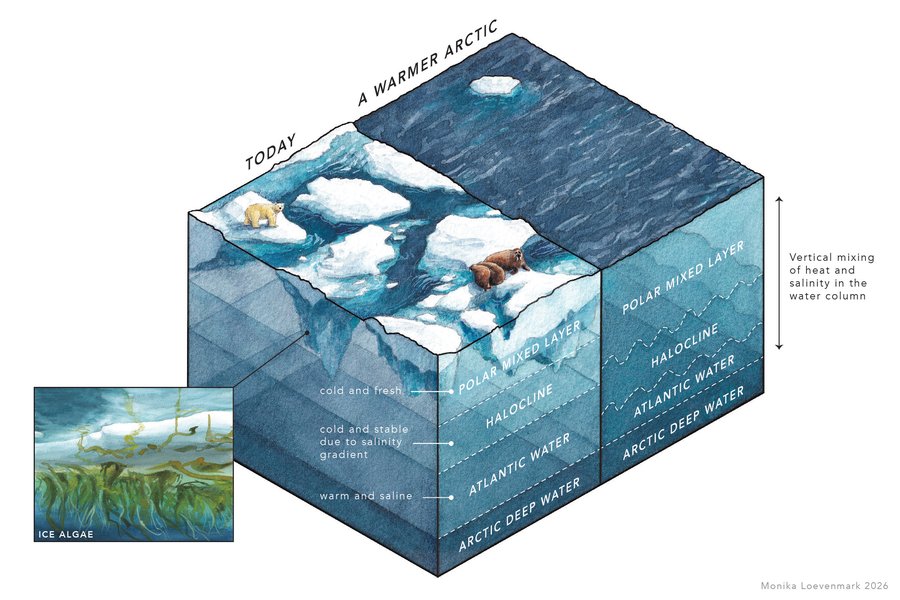
A weakened Beaufort Gyre could allow more freshwater to enter and spread through the Arctic Ocean, disrupting the stable layering that currently keeps surface and deeper waters largely separated. This stratification is important because it acts as a barrier that limits the upward movement of warmer, deeper water. When that barrier weakens, increased mixing can bring heat closer to the surface, accelerating sea ice melt.
At present, strong, persistent stratification limits the upward mixing of warmer water, preventing sea ice melt, which is important as sea ice creates habitat for Arctic animals and for ice algae, a foundational food source for marine life.
A reduction in sea ice means ice algae and habitat loss, and the absorption of more heat into the ocean that the ice previously reflected. Destabilizing the local marine ecosystem will also affect local Arctic fisheries, disrupting fishing and indigenous marine subsistence.
The impact of the Beaufort Gyre on the AMOC
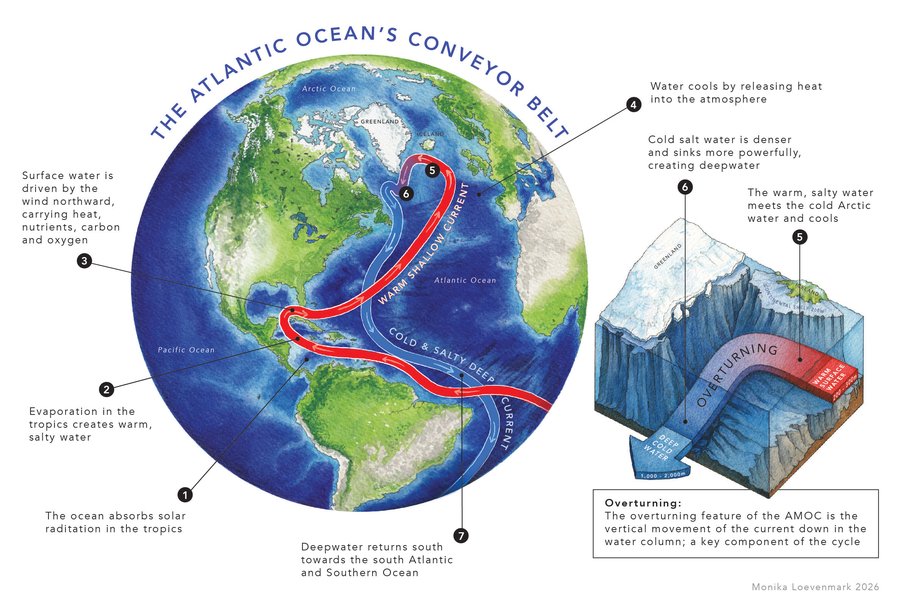
The AMOC is a major system of ocean currents in the Atlantic Ocean that acts as a large conveyor belt, transporting water, heat, and nutrients across a large portion of the planet.
It works through a continuous loop in which warm, salty surface water flows northward from the tropics toward the North Atlantic, where it cools, becomes denser, and sinks, forming deep water that returns southward toward the Southern Hemisphere. This circulation helps redistribute heat across the globe, moderating the climate (particularly in the North Atlantic region) and influencing weather patterns, storm tracks, rainfall, and sea level along coastlines.
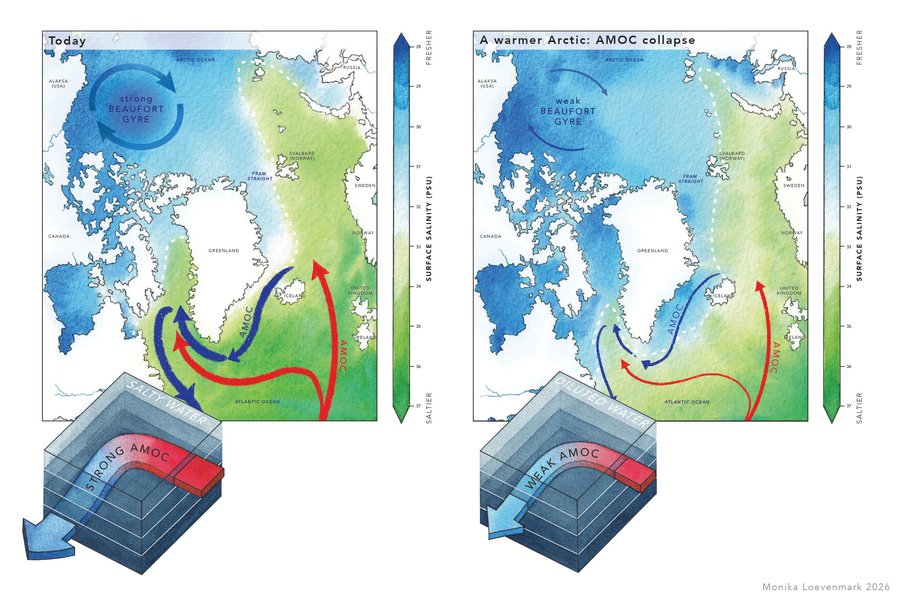
The weakening of the Beaufort Gyre poses a direct threat to the strength of the AMOC, as freshwater will enter the Fram Straight via the transpolar drift and impact the salinity stratification of the North Atlantic Ocean. It is this salinity that powers the overturning of the AMOC.
In a colder, stable Arctic scenario, the Beaufort High is maintained, thereby perpetuating the clockwise spin of the Beaufort Gyre. The North Atlantic sustains salinity levels, and as warm, salty water from the tropics meets cold Arctic water, it sinks into cold deep water and moves southward, driving the AMOC’s cycle. However, in an unstable, warming Arctic scenario, the Beaufort Gyre will weaken, releasing fresh water into the Atlantic Ocean. The influx of fresh water into the North Atlantic will dilute the warm, salty water arriving with the AMOC and prevent it from sinking, slowing the whole cycle.
Global impacts of a weakened AMOC
Since the Atlantic Meridional Overturning Circulation plays a central role in redistributing heat, regulating climate, and supporting ocean productivity, a significant weakening would have far-reaching global consequences. By transporting warm surface waters northward and returning cold deep waters southward, the AMOC helps shape global climate regulation, the creation of atmospheric winds and moisture that influence predictable regional weather patterns, and the delivery of precipitation to agricultural belts, which are essential for crop production.
If the AMOC were to weaken substantially, these interconnected systems would be disrupted. Regions such as Europe, especially in Northern Europe, could experience cooler conditions with a magnitude of a 5-10°c drop due to reduced northward heat transport, alongside shifts in storm tracks and precipitation patterns.
Southward shifts in tropical rain belts will cause droughts and disrupt global agriculture; marine ecosystems will be disrupted by reduced nutrient transport, and global fisheries disruption as fish stocks shift toward cooler, deeper waters.
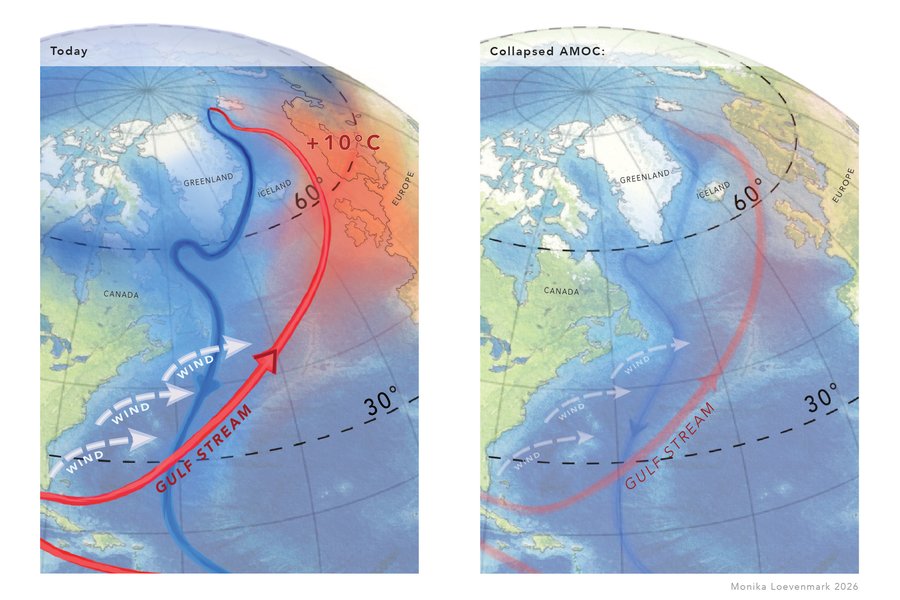
Other abrupt and catastrophic impacts of the collapse of the AMOC will include reduced sea ice, resulting in Arctic habitat loss, food web disruption, and reduced heat reflection, further warming the ocean.
Additionally, there will be more frequent natural disasters and unpredictable global weather patterns, sea-level rise affecting coastal cities, and a weakened Gulf Stream carrying less heat and nutrients northward.