February 12, 2026
Spotting a polar bear during everyday tasks is unimaginable for most, but in Churchill, Manitoba, and Longyearbyen, Svalbard, it’s increasingly common as sea ice declines and bears spend more time on land.
Coexisting with polar bears involves a unique set of considerations, including educating residents and visitors about polar bear safety, minimizing attractants and food rewards, managing waste, ensuring responsible tourism, and having clear plans for when a bear approaches town.
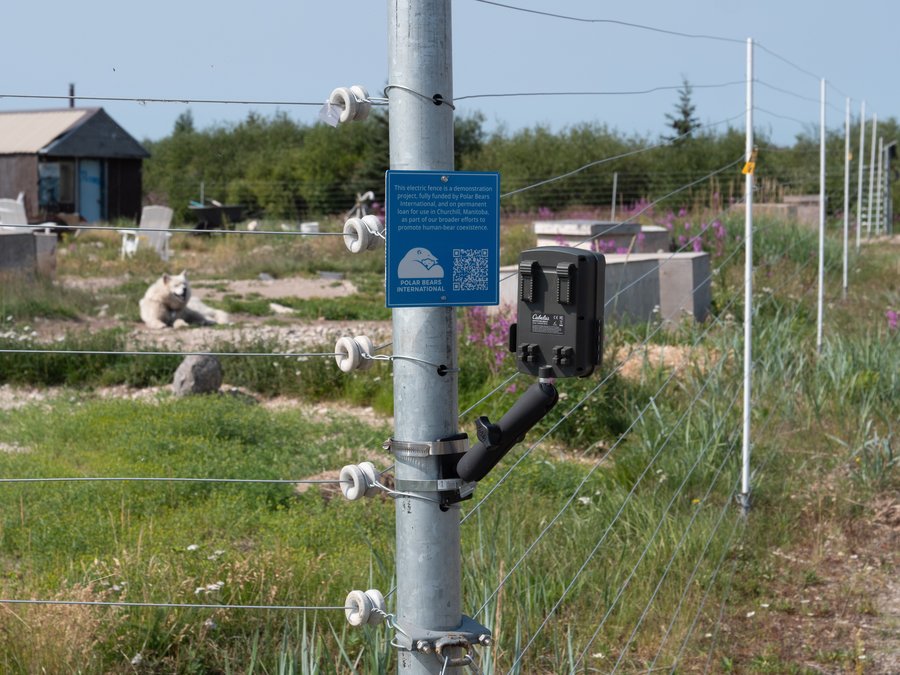
Coexisting with polar bears involves a unique set of considerations, including educating residents and visitors about polar bear safety. (Credit: Kieran-McIver)
To help communities adapt, Polar Bears International (PBI) is working with residents of both communities, as well as people in remote parts of Northern Ontario (including Kashechewan, Peawanuck, and Attawapiskat), to facilitate the sharing of knowledge and lived experience with polar bears. The first exchange took place in Churchill in 2024, followed by a second in Svalbard in 2025.
“Both communities have a lot of potential for bears to come in or near town, and both have different cultural approaches towards living around polar bears,” said Geoff York, PBI’s Senior Director of Research and Policy.
The exchanges provided an opportunity for people from different cultures and parts of the world to share and learn from one another.
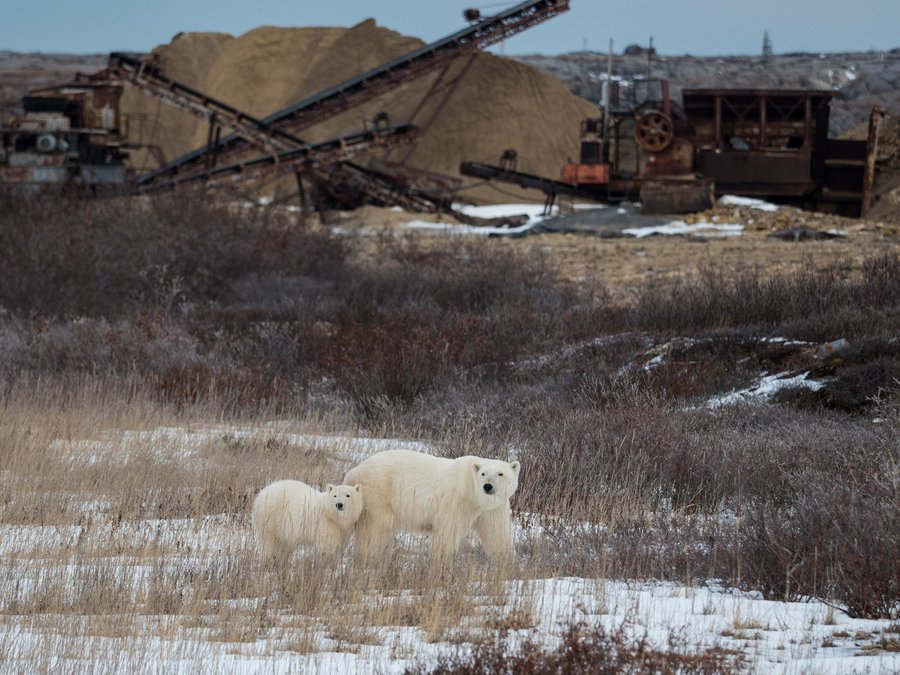
Both communities have a lot of potential for bears to come in or near town. (Credit: Madison-Stevens/PolarBearsInternational)
Churchill: The Polar Bear Capital of the World
Each fall, thousands of visitors come to see the polar bears that congregate on Hudson Bay’s shores before the water freezes and the animals head out to hunt seals.
Due to the close proximity between the town and the bay, encounters are frequent, with more than 220 polar bear occurrence reports in 2024. The Polar Bear Alert program operates a hotline for reporting sightings, with staff ready to respond and chase the bears from town or, if necessary, place them in the Polar Bear Holding Facility.
During the 2024 community exchange in Churchill, participants visited the Polar Bear Holding Facility, joined a Polar Bear Alert program ride-along, ventured out into the Churchill Wildlife Management Area to see polar bears, and attended a deterrence training session that involved familiarization with tools like handheld flares, bear spray, noise crackers, and rubber bullets. They also discussed life in Churchill and how generations have coexisted with bears.
“Churchill is a multi-generational community,” York said. “You have Indigenous people that have been in that region for millennia and have a very, very long history of living in the north, living around black, brown and polar bears. And so there's just this deep history there that's passed down.”
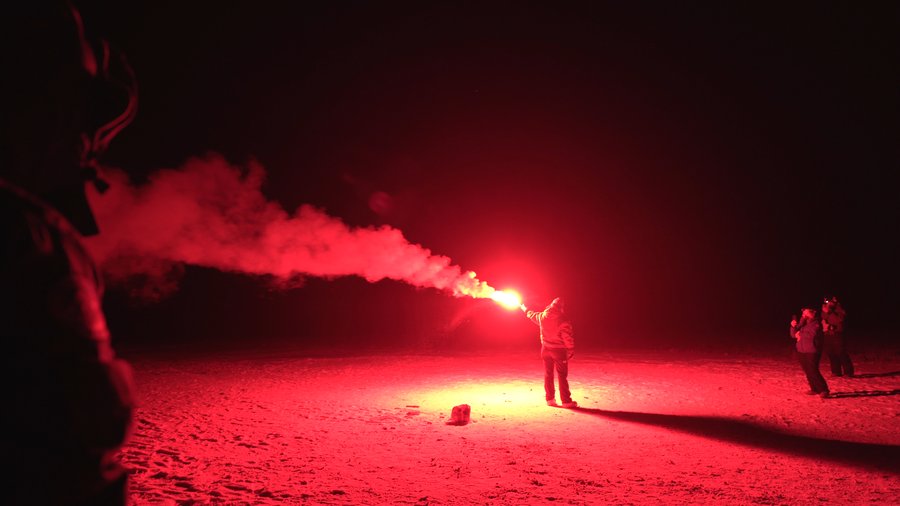
During the 2024 community exchange in Churchill, participants attended a polar bear deterrence training session that involved familiarization with non-lethal tools like handheld flares, bear spray, noise crackers, and rubber bullets. (Credit: Handcraft)
Svalbard: A Community in Constant Transition
In contrast, Svalbard is a relatively itinerant community that was initially geared towards coal mining. According to a 2016 study, residents of Svalbard stay for an average of just seven years and have minimal experience coexisting with large predators.
“None of us encounter polar bears weekly, but it does impact our lives,” said Hilde Fålun Strøm, one of the few long-term residents of Longyearbyen, who has lived there for 30 years. “When we're outside of the little community of Longyearbyen, we always carry deterrents.”
Strøm has more polar bear experience than most residents, facing more than 100 encounters during the 19 months she spent living in a trapper’s cabin in a remote part of Svalbard as part of Hearts In The Ice. As an Ambassador at Large for PBI, Strøm helped organize the exchanges.
In Svalbard, participants sat around a bonfire enjoying bidos reindeer stew, sailed on M/S Sjøveien to visit the small community and research hub of Ny-Ålesund, and visited the local waste management facility — all while exchanging perspectives, knowledge, and presentations.
"Sharing knowledge is so important and so fruitful, I think, for all parties."
Dialogue: Key to the Community Exchange Program
Peer-to-peer discussions and the exchange of ideas are key goals of the program, along with building the groundwork for future collaboration, finding ways to share information broadly, and providing input on training.
Participants took time to chat with their counterparts about their jobs and the day-to-day challenges of living in northern communities. Fostering these personal connections creates a network of support to last long after participants return home.
“[They] can literally pick up the phone or send an email and say, ‘Hey, what are you doing about this there?’” York said.
Residents of the participating communities have appreciated the opportunity to exchange information and learn from one another. For instance, one major topic during the exchanges was waste management.
“Around the north and the Arctic, solid waste management is a big problem,” York said.

Bear bins in Churchill. One major topic during the exchanges was waste management. (Credit: Erinn Hermsen)
Although plastic and canned goods packaging work well for shipping products to northern communities, they leave communities grappling with how to manage the waste they generate. Landfills and burning are options, but they can be challenging and have several disadvantages. Frozen ground makes burying waste difficult, and remote locations can make shipping trash and recycling out impractical and cost-prohibitive. To make things even more difficult, Churchill’s waste management facility burned down in 2024.
The Canadian exchange participants enjoyed learning about Svalbard’s waste management system, which features large metal containers with small openings with latches to accept trash and recycling. The entire container load is trucked to indoor facilities for sorting, bundling, compressing and shipping to the mainland. This system helps keep bears out of town since there isn’t trash to serve as an attractant or food reward.
According to Strøm, Longyearbyen has no Indigenous communities and is, in many ways, a young society. As a result, its storytelling traditions are far shorter than those of the Indigenous communities in and around Hudson Bay.
“Churchill has so much to offer to us in Longyearbyen,” she said. “They have been living with polar bears forever.” Currently, PBI is working to create more opportunities for knowledge exchanges in the future.
“Sharing knowledge is so important and so fruitful, I think, for all parties,” Strøm said. “I'm very proud to be part of it.”