December 04, 2025
Each year, a population of narwhals spend their summers in Nunavut’s Tasiujaq (formerly known as Eclipse Sound), but their numbers are dwindling fast. Just over 2,000 were estimated in 2021, a dramatic decline from the 20,000 in 2004.
“Growing up as a young hunter in the ’90s and early 2000s, the narwhal numbers were vastly higher,” said Alex Ootoowak, Field Technician for Oceans North and lifelong resident of Pond Inlet
Ootoowak is part of an international research team investigating the causes of the decline, noting that Narwhals are crucial for Inuit culture and subsistence.
“As far back as I remember, it’s been part of our culture to hunt and harvest narwhals,” he said. “We’ve tried to do our best to keep the population healthy and alive so that future generations have this means of food in our freezers.”
Some scientists believe that rising ship traffic may be a contributing factor, as narwhals rely on echolocation to navigate and communicate.
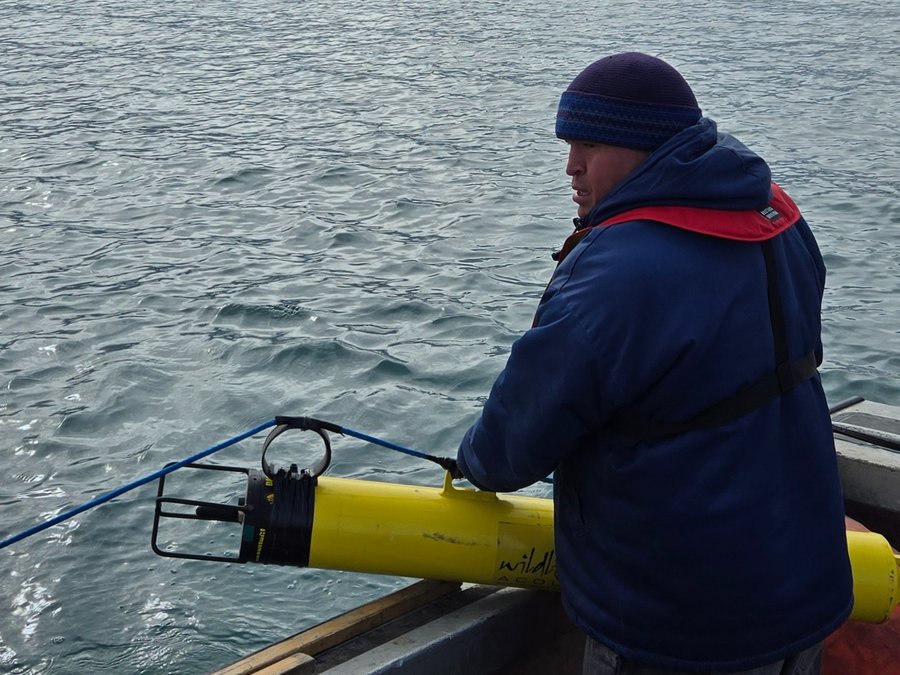
Alex Ootoowak deploying a short term hydrophone in Milne Inlet summer 2025 (Credit: Julie Killiktee)
Between 2015 and 2019, vessel transits increased by 384 percent through the eastern entrance of the sound, an inlet located between northern Baffin Island and neighbouring Bylot Island. Approximately 80 percent of those transits were related to mining, while most of the others were tourist vessels. As climate change continues, causing more extended periods of open water, ship traffic in Eclipse Sound is expected to increase.
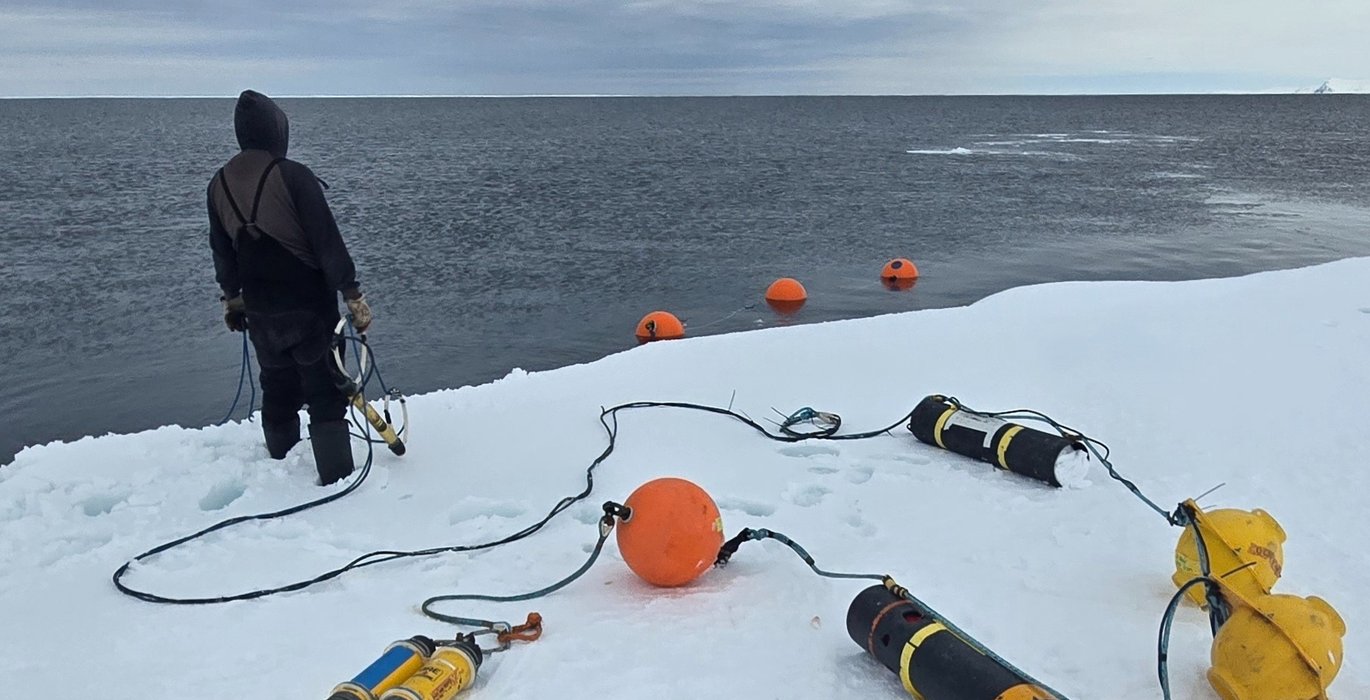
Researchers from Oceans North, Mittimatalik Hunters & Trappers Organization, Scripps Institution of Oceanography, and other partners teamed up to examine underwater acoustic recordings and ship data from 2016 to 2021 to learn more about the region’s narwhals. They deployed sensors that recorded echolocation clicks, paying particular attention during July and October, when they expected both narwhals and ships to be present at the same time.
“They stay at the intersection between the landfast ice and the pack ice of Baffin Bay during the spring and wait until the ice opens up. And as soon as they can, they go into their summering region,” said Joshua M. Jones, principal investigator on the project and Assistant Project Scientist at the Marine Physical Laboratory at Scripps Institution of Oceanography at the University of California, San Diego.
He added that they often return months later in the Fall, when the seasonal advance of ice reoccurs.
“At that point, as the ice forms, the animals leave their summering area and pass our site again.”
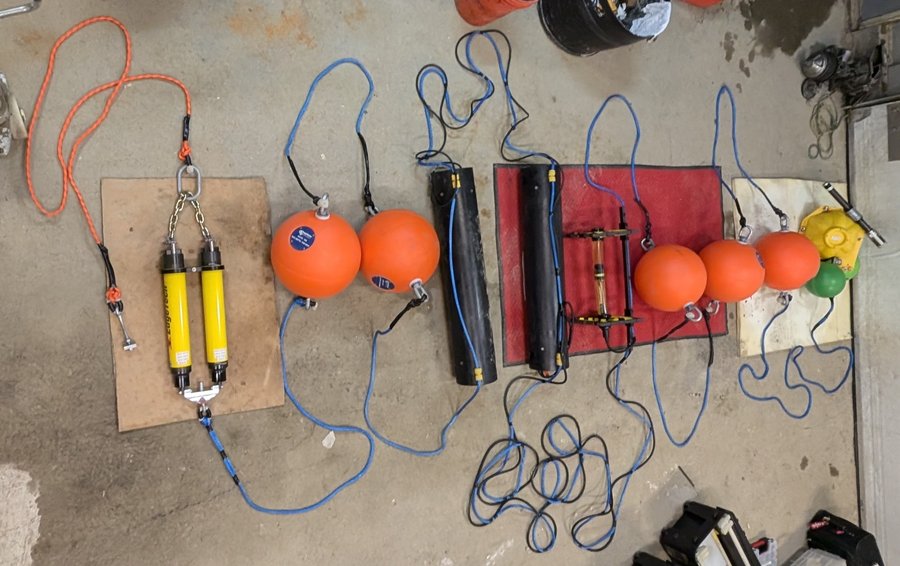
Mooring setup before deployment (Credit: Alex Ootoowak)
Researchers found that narwhal acoustic presence decreased when ships were detected nearby, with the most noticeable impact found when ships were recorded within 20 kilometers of the sensors.
In 2025, the researchers published their findings in Scientific Reports, building on some of the team’s previous research, which found narwhal patterns changed when ships were detected within 10 kilometers. These new findings reveal that narwhals may be even more sensitive to underwater sounds than previously believed.
Additionally, the researchers found a strong correlation between narwhal detection and the time of year and the environmental conditions they recorded. They discovered that narwhal acoustic presence peaked once during July’s sea ice breakup, and then again when the sea ice refroze in October. Once sea ice concentration topped 80 percent, acoustic sounds declined, a decline that also occurred during periods of open water.
These findings were consistent with Inuit knowledge about narwhals’ migratory patterns in the region.
“Inuit knowledge of the animals was really important in guiding the experimental design,” Jones said.“One of the most important takeaways from this project is that Inuit already know the answers to many of these questions about how animals are impacted by ships and other human activities.”
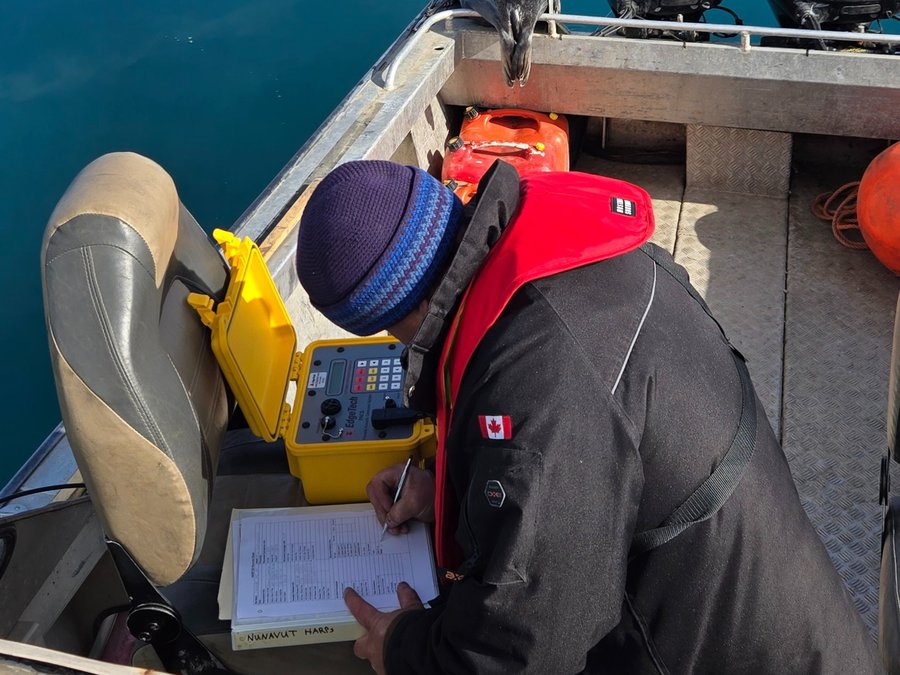
Alex Ootoowak filling out a deployment sheet in Milne Inlet summer 2025 (Credit: Atiqtalaaq Uuttuvak)
Researchers can't be sure whether a decline in acoustic signals means narwhals have stopped vocalizing or moved to a new location, but either behaviour could potentially be related to external factors such as ship traffic or climate change. Researchers also noted that vocalizations stopped and restarted when ships were at approximately the same distance, indicating a possible connection between ship presence and the animals’ silence.
“As we assess underwater noise impacts on marine wildlife around the world, we really need to use caution when we start with assumptions about what animals can hear and how sensitive they are,” Jones said. “This study really highlights the importance of assuming that animals hear very well and are very sensitive to noise, and that certainly was the case here.”
Researchers continue to record and study underwater sound at various locations to gain a deeper understanding of its potential impact on wildlife. Learning more about how ships, underwater noise, and other factors impact narwhals is also crucial for local residents like Ootoowak, who rely on narwhals for culture and subsistence.