July 16, 2026
Northern Alaska’s landfast ice season is getting shorter, shrinking a critical resource for the communities and ecosystems that depend on it.
This sea ice has long supported transportation routes, hunting and fishing, and access to nearshore oil and gas facilities. It also protects the shoreline from storms and strong waves, which can cause erosion, while serving as habitat for species like ringed seals — and the polar bears that prey on them — as well as shorebirds and a variety of species that use the ice and nearby open water.
“Landfast ice is the most encountered form of ice that there is,” said University of Alaska Fairbanks research professor of geophysics Andy Mahoney, noting that Arctic populations are largely concentrated along the coast, where this ice is both familiar and essential.
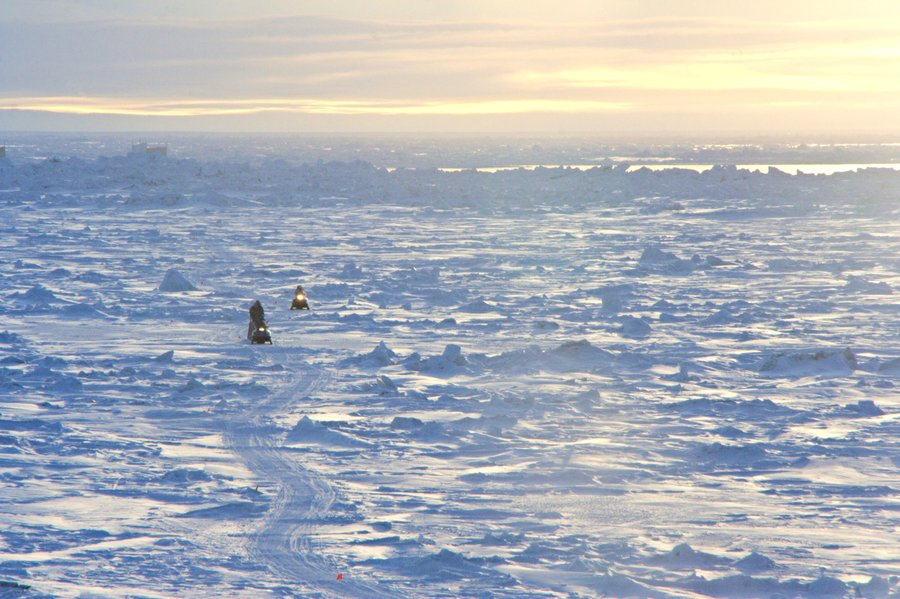
Community members traveling over landfast ice returning to the shore from the lead edge. (Credit: Andy Mahoney)
In a recent study published in the Journal of Geophysical Research: Oceans, Mahoney and coauthor Andrew Einhorn extended earlier datasets to create a 27-year record of landfast sea ice, focusing on the Chukchi Sea off the coast of northwestern Alaska and the Beaufort Sea to the north of Alaska. Their analysis reveals that the extent of Beaufort landfast ice, which remained relatively stable from the 1970s to the early 2000s, is now declining.
“We're seeing the same changes now starting to emerge in the Beaufort Sea that we've previously seen in the Chukchi Sea,” Mahoney said.
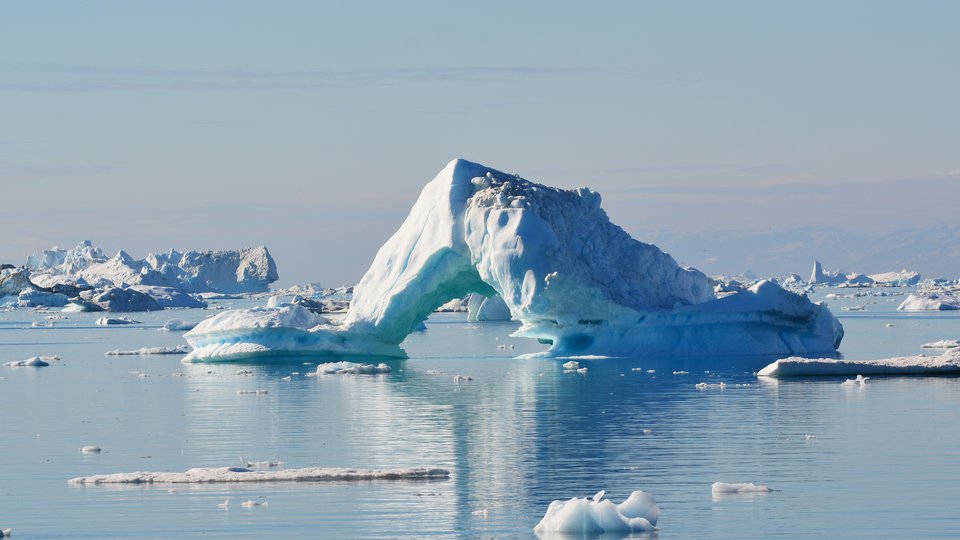
Landfast ice is usually seasonal, forming in fall or early winter and breaking up in spring or summer. However, in some areas, such as parts of northern Canada and Antarctica, there is multi-year landfast ice. Its appearance can vary from fairly smooth in sheltered areas to rough, jumbled ice in more exposed locations.
The ice attaches to land while it forms and freezes directly to the coastline, or when ice becomes “anchored” by attaching to shallow seafloors. Ice can also become landfast by attaching to ridges of already-anchored ice. These conditions come about when winds push drifting pack ice against the shoreline, piling it into features that can extend down to the seafloor.
“We call those grounded ridges,” Mahoney said. “They’re sort of like an island of ice that’s formed by the ice itself, and those are really important for stabilizing the landfast ice and allowing it to extend outward from the coastline.”
When warming or thawing weakens the ice, it can become unstable, making it more prone to breakup by wind and ocean currents — ending the condition of landfastness by detaching from the shore.
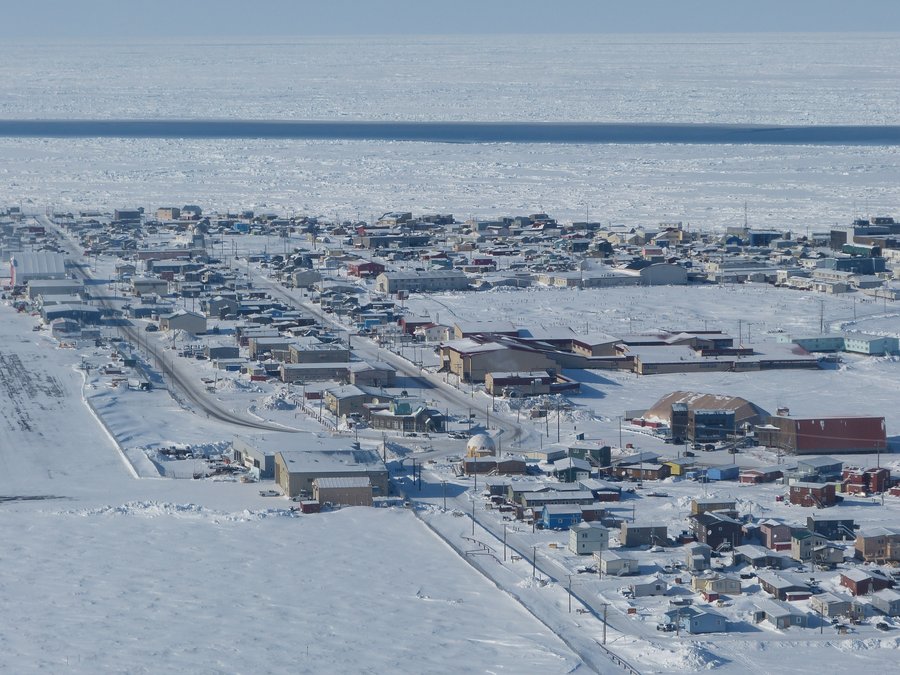
Landfast sea ice near the community of Utqiagvik with an open lead at its edge and drifting pack ice beyond. (Credit: Andy Mahoney)
While this process is part of the annual cycle in much of the Arctic, the landfast ice season is getting shorter.
During the study period from 1996 to 2023, Mahoney and fellow researchers found that the Chukchi Sea landfast ice season shortened by 19 days per decade, with ice generally attaching later in fall and detaching earlier in spring. They also found that landfast ice seasons had shortened by 13 days per decade during the 27-year study period in the Beaufort Sea. This reduction was mainly due to the later formation of landfast ice each season.
“We hadn’t necessarily expected to see these changes in the Beaufort Sea,” Mahoney said. “When we analyzed our data and looked at the most recent years in particular, I wasn’t necessarily expecting that result to pop out so cleanly.”
During the study period, the total amount of landfast sea ice along the U.S. Outer Continental Shelf also dropped significantly. During the first nine years of the authors’ study period, landfast ice made up 3.8 percent of this area; however, by the final nine years of the study (2014 to 2023), only 2 percent of this area was landfast ice.
"Everywhere we look in the Arctic, particularly related to sea ice, we see the same pattern of trends."
The continental shelf is economically important for offshore mineral, oil, and gas resources, and the landfast ice is often used as a platform for these activities. The landfast ice can be used for exploration, ice roads, and production platforms. A longer open-water season makes these operations — and access in general — more challenging, especially in shallow and difficult-to-access areas.
Since landfast ice serves many purposes, many stakeholders are interested in understanding how its seasonal patterns are changing.
“Everywhere we look in the Arctic, particularly related to sea ice, we see the same pattern of trends. Whether you're talking landfast ice, pack ice, thickness, or extent of the ice, we’re seeing reductions in all of those things over multiple decades.”
Mahoney and his colleagues are continuing their research on landfast ice and developing tools to monitor for early warning signs that indicate when it will detach. They are also working on ways to monitor these remote regions even more closely.
“We're planning a more targeted research program, trying to develop ways to identify these grounded ridges from space, which would allow us to monitor them more easily in the longer term, and then also really understand how important they are for stabilizing the landfast ice, looking at how they actually anchor it in deep water,” Mahoney said.
The Arctic continues to warm much faster than the rest of the world, and the resulting reduction in sea ice continues to affect people and ecosystems. Mahoney and his colleagues remain committed to studying these patterns of change and providing knowledge to help people monitor and adapt to them.