January 22, 2026
When geomicrobiologist James Bradley and his team arrived at Svalbard in February 2025, he expected the usual Arctic fieldwork challenges — delayed flights, snowstorms, and subzero temperatures. Instead, at their research station in Ny-Ålesund, the team faced rain, unseasonably warm temperatures, and spring-like vegetation poking through melting snow.
According to the team, “wintertime warming and rain turned Ny-Ålesund and the surrounding landscape into a melting ice rink.”
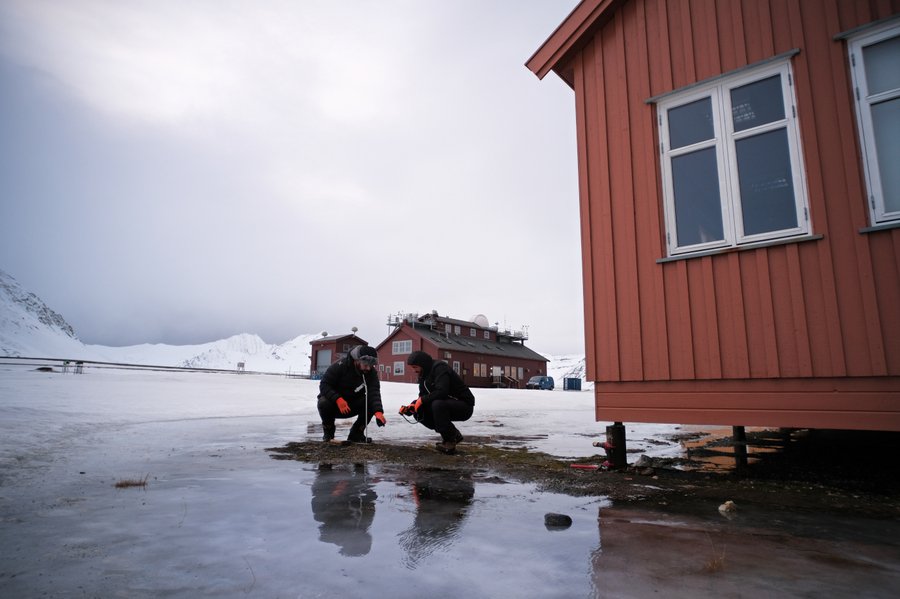
At their research station in Ny-Ålesund, the team faced rain, unseasonably warm temperatures, and spring-like vegetation poking through melting snow. (Credit: Jacopo Pasotti)
Bradley, a CNRS CPJ researcher with the Mediterranean Institute of Oceanography in France, has been conducting research on Svalbard since 2013. He and his colleagues, ready for sample collection with their usual tools, including snowmobiles, drills, and ice picks, were shocked by the local conditions.
While the average February temperature in the area from 1961 to 2001 was -15 °C, in February of 2025, the average air temperature rose to -3.3 °C, with a maximum of 4.7 °C. Of the 28 days in the month, 14 saw temperatures above freezing.
Bradley and his colleagues published their Ny-Ålesund observations in Nature Communications, stating, “Increasingly frequent winter thaw events are reshaping Arctic landscapes, signalling a dramatic shift towards a new Arctic.”
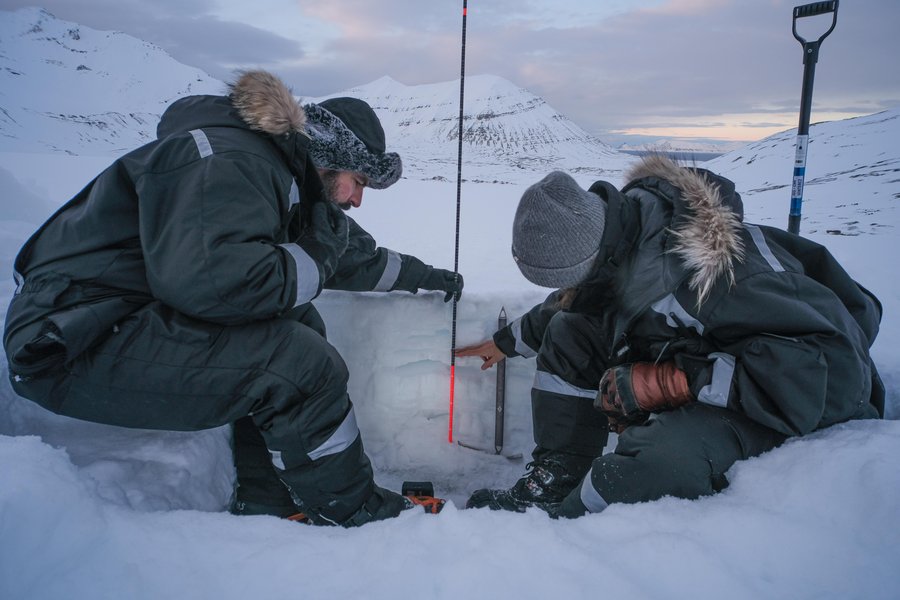
While the average February temperature in the area from 1961 to 2001 was -15 °C, in February of 2025, the average air temperature rose to -3.3 °C, with a maximum of 4.7 °C. (Credit: Jacopo Pasotti)
The authors noted that Svalbard is warming at a rate six to seven times the average global rate, with the most dramatic warming occurring during winter. In recent decades, this has led to an increasing number of “rain-on-snow” events, where rain falls on top of an existing snowpack, which can result in flooding and other concerns. They added that by the end of this century, rain is projected to become the dominant form of precipitation across the Arctic.
”We can't really expect the Arctic to be reliably frozen through the winter anymore,” Bradley said. “What this has shown us is that these melting events can be severe and widespread and persistent, and they're not really an anomaly.”
When precipitation falls as rain, it increases the speed of snow melt, exposing soils and the biological and microbial communities within them to cold temperatures and freeze-thaw cycles.
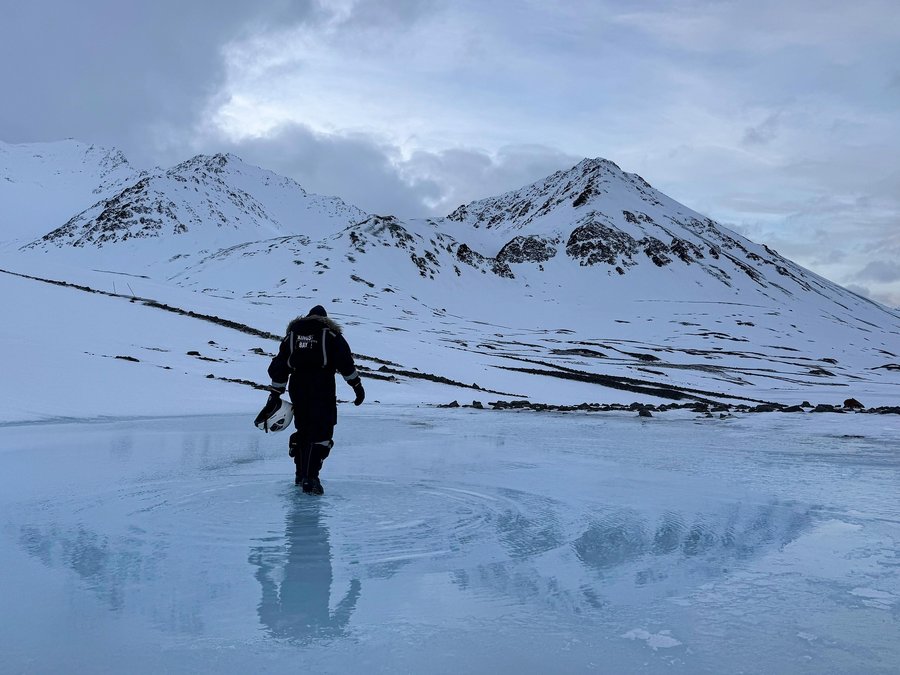
By the end of this century, rain is projected to become the dominant form of precipitation across the Arctic. (Credit: James Bradley)
Bare ground allows water to seep in and refreeze, creating an impenetrable layer that causes meltwater and rain to pool on the surface while impeding the exchange of gases between the soil and atmosphere. It also allows vegetation to emerge and grow early, but lacks the insulation to protect roots, soil, and other fragile ecosystem components from further freeze-thaw cycles.
Additionally, warmer weather can create dangers for residents and researchers alike. Freeze-thaw cycles also led to greater snowpack instabilities and increased avalanche hazard, altering the risk profile of field excursions. Warm temperatures also cause streams and rivers to thaw earlier, and the melting of permafrost creates unstable layers that impact human structures, such as research stations.
“If a well-equipped Arctic research base is struggling, what are remote communities facing?” Bradley said.
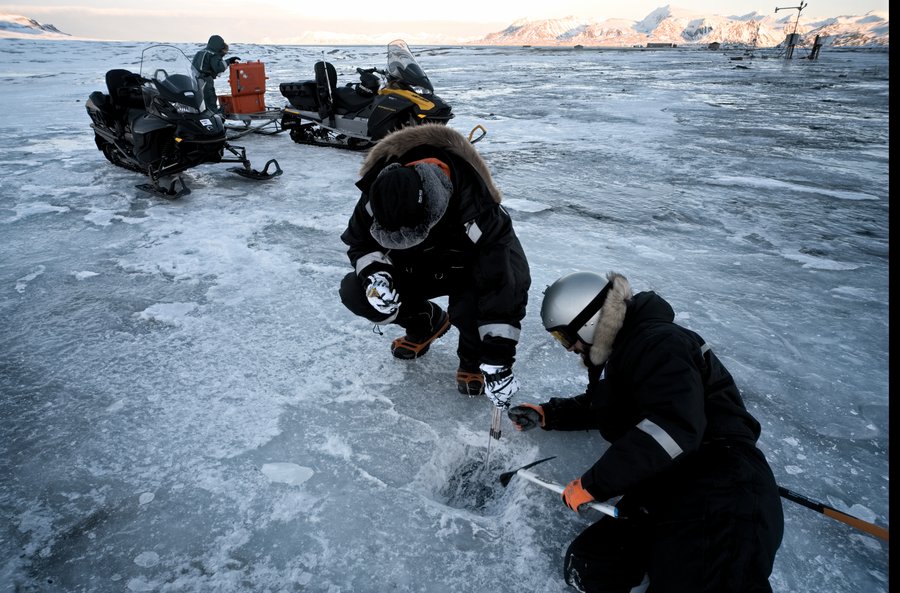
Warmer weather can create dangers for residents and researchers alike. (Credit: Jacopo Pasotti)
Bradley and his fellow researchers were working on several projects, studying topics such as terrestrial microbial communities and their roles in carbon and other cycles during the cold, dark winter conditions. The team planned to sample freshly fallen snow from several locations and extract DNA from microbes to learn about energy metabolism in Arctic conditions. However, the warm conditions and rainfall required a few changes to these projects.
“We had to approach how we would do the sampling in a different way,” said Bradley. “All of that snow was melting, so we didn't really have any fresh snow falling from the sky. We just had rainfall.”
Other researchers were also forced to adjust their studies of microbial activity in winter soils and the microbial processes that drive carbon cycles, and other elements. One team was prepared to extract frozen soil samples using various tools, such as drills and ice picks, but ultimately resorted to using a spoon because the ground had thawed significantly.
“It's a risk to the field campaign, that it might not be successful if the samples that we want to collect are not accessible or not available,” Bradley said.
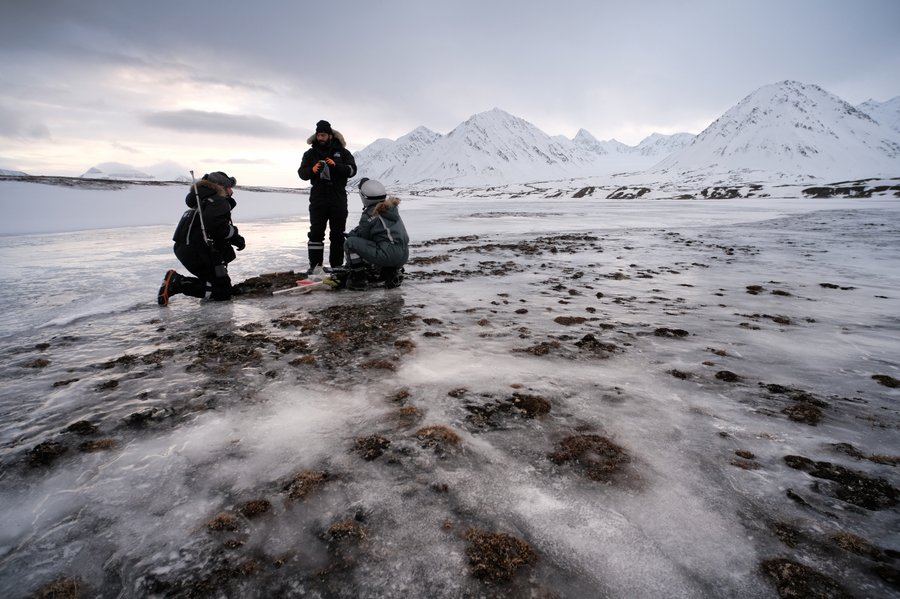
One team was prepared to extract frozen soil samples using various tools, such as drills and ice picks, but ultimately resorted to using a spoon because the ground had thawed significantly. (Credit: Jacopo Pasotti)
The authors noted that their findings raise concerns about the “long-term feasibility of winter research practices and logistics under increasingly variable conditions and rising temperatures.”
Bradley added that “It was a strong emotional weight that we all kind of carried.”
Despite the difficulties, Bradley says it remains vital to gather data to establish baselines and monitor changes, so they can gain a better understanding of how climate change is impacting Svalbard and beyond.
“As we talk about future risks of climate change, what we're seeing is that this is having an effect right now. I also think that we need to start thinking about the winter season as not just a season where nothing is happening anymore, but a season of risk.”
Banner Image Credit: James Bradley