March 05, 2026
Thomas V. Schuler’s team was confronted with a startling sight when they returned to a glacier in Norway’s Svalbard archipelago to service research equipment; the data logger they had installed flush with the snow surface several months earlier was suspended three meters in the air. The glacier beneath it had vanished faster than anyone expected.
The discovery marked the beginning of what researchers now describe as a record-breaking melt season. During a roughly six-week period in the summer of 2024, Svalbard lost about 1 per cent of its total ice volume. Located in the High Arctic, glaciers cover around 53% of Svalbard’s land surface. The total ice loss was calculated at around 61.7 gigatons, similar to the amount of ice the Greenland Ice Sheet (which is 50 times larger than Svalbard) lost over a similar period.
“This ice loss was far outside of everything that we had experienced before,” said Schuler, a Professor in the Department of Geosciences at the University of Oslo. “That was the starting point of looking more into detail of this very special summer of ’24.”
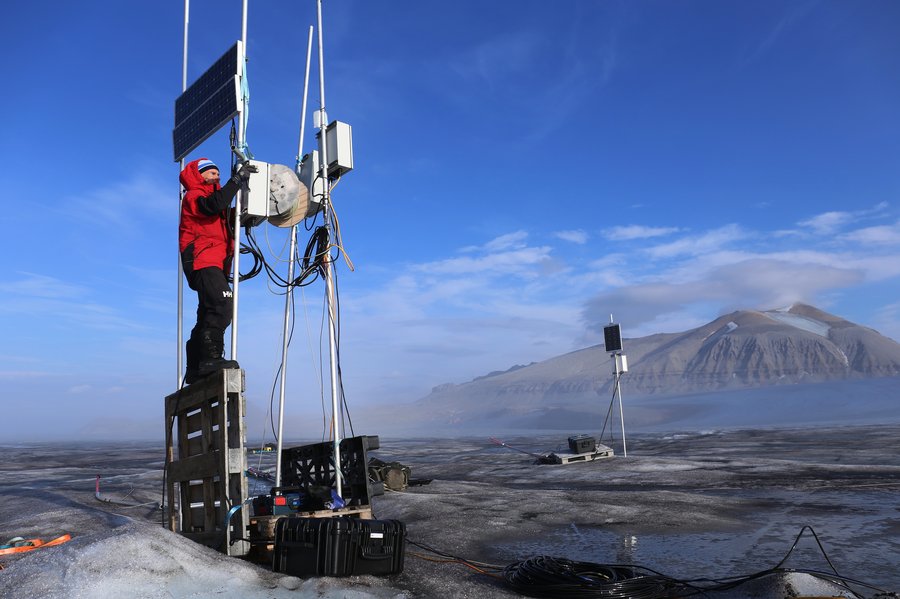
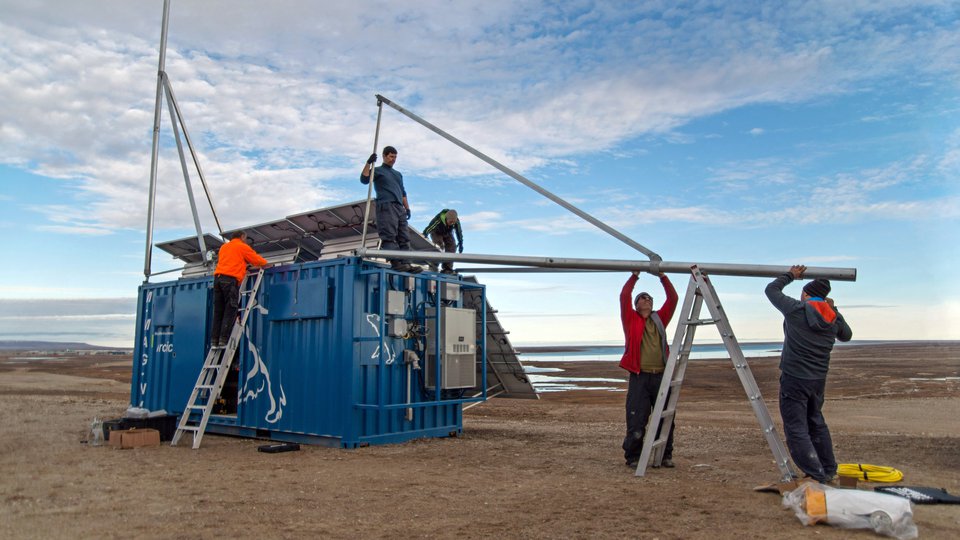
The severe ice melt challenged fieldwork for maintenance of glacier survey equipment. During the previous visit in April 2024, the solar panels were just above the snow surface. (Credit: Shin Sugiyama)
To verify the findings, the scientists reexamined their research. They collected more field observations and submissions from a range of colleagues, studied the reliability of their modeling calculations and the remote sensing data, and utilized independent measurements of isostatic uplift of the Earth’s crust, which responds to changes in glacier mass. They wanted to see how their observations compared to the previous 30 years
“We saw in all of these different measurements, a very coherent picture of a record ice loss from Svalbard in summer 2024,” Schuler said.
The rapid ice melt was caused by record-breaking summer temperatures in Svalbard. The authors noted that Svalbard Airport’s recorded air temperature between July 23 and September 8 exceeded the 99th percentile for temperature (based on 1991-2020 records) on 23 out of 46 days, leading to the massive glacial melting.
“It was a very, very extreme event,” Schuler said. While such heat would historically be expected only once every several centuries, he notes that estimating the frequency of unprecedented extremes is inherently difficult.
Melting glaciers impact people, communities, and ecosystems far beyond this Arctic archipelago and contribute to global sea level change. In 2023, scientists found a global mean sea level rise of 4.5 mm per year, a steep increase from the 2.1 mm per year recorded in 1993. Rising sea levels can flood low-lying coastal areas and lead to other impacts. They can also harm terrestrial and marine ecosystems.
When water from melting glaciers flows into Svalbard’s streams and rivers, this freshwater—along with whatever sediments, minerals, and other substances it may carry from the glacier—can cause wide-ranging impacts on these ecosystems and the plants and animals that live there, including terrestrial animals like reindeer.
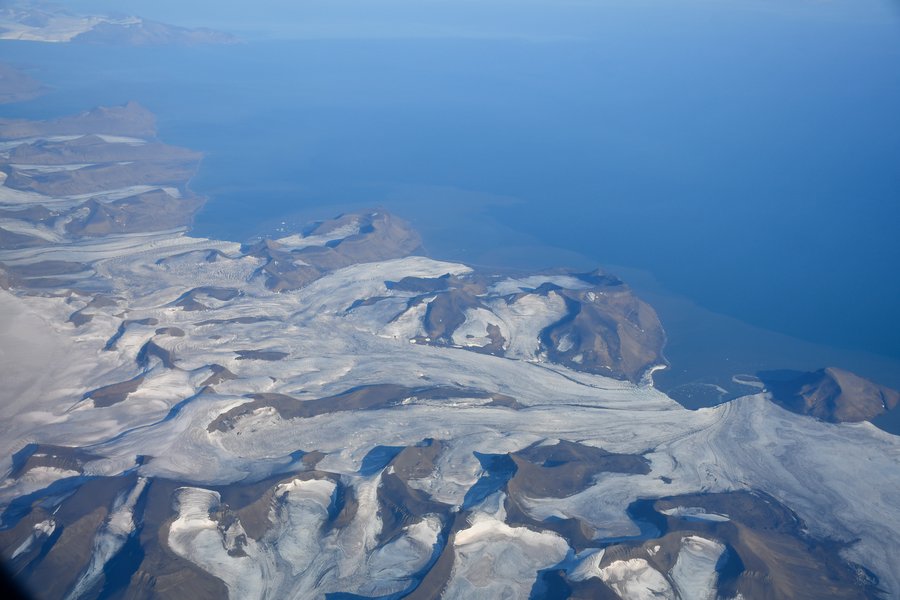
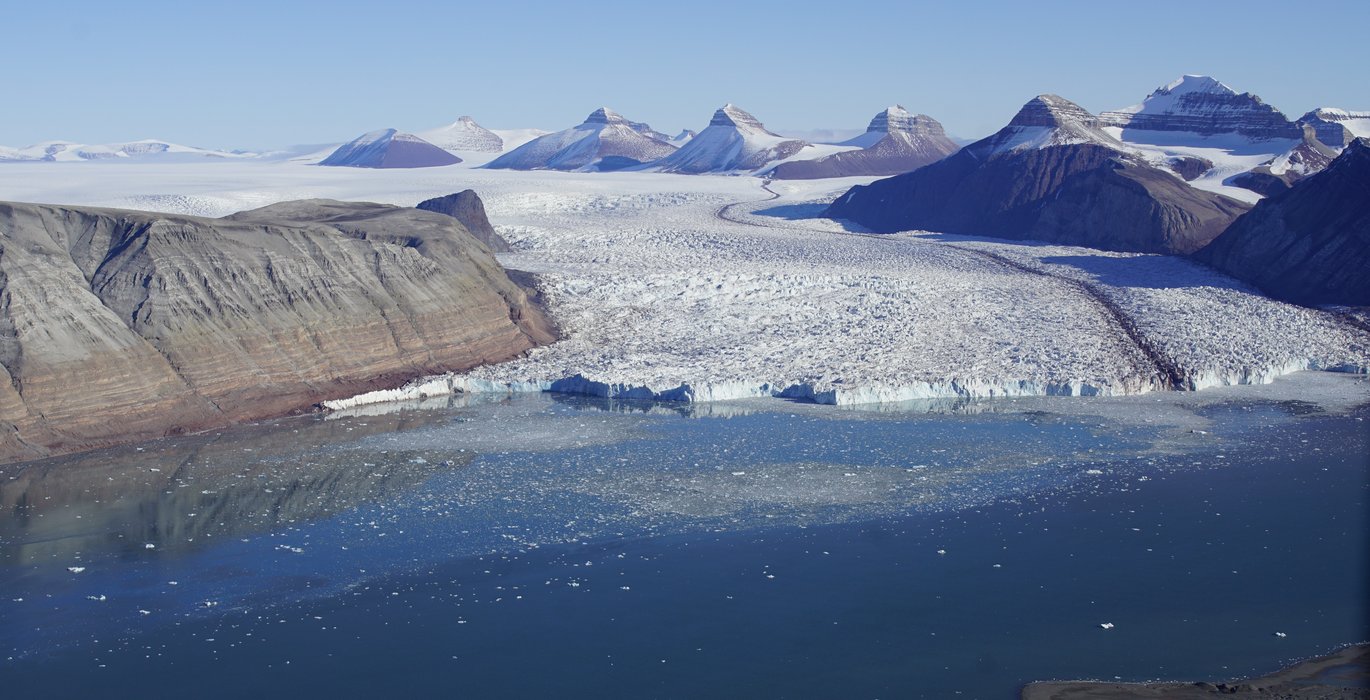
Aerial view of glaciers in South-East Svalbard in August 2024 after several weeks of intense melting. Almost all snow has disappeared, exposing the bare ice at the surface. (Credit: Ketil Isaksen)
When runoff reaches the sea, this influx of freshwater can also change the composition of seawater. The shifting mix of freshwater and saltwater can alter the ocean water’s buoyancy and composition, leading to changes in ocean circulation.
Organisms that live in the ocean are generally adapted to the area’s typical level of salinity, so an influx of freshwater can negatively impact them, and some organisms trapped in freshwater plumes may experience osmotic shock, which can be fatal.
The impacts of these marine ecosystem changes can ripple through wider ecosystems and the food web. The areas where melting glaciers drain into fjords are also hotspots for wildlife, such as birds, fish, seals, and even polar bears, so these changes can have drastic impacts.
While the scale of Svalbard’s 2024 melt is alarming on its own, scientists point to the fact that this type of melt—along with all its ecosystem implications—may become increasingly common in the coming years and decades.
Schuler and colleagues shared their findings in a PNAS study in which they wrote that "future climate projections suggest that such temperature levels will become increasingly commonplace by the end of the 21st century, potentially even surpassing those of 2024."
While the summer of 2024 remains an outlier for now, the researchers say hot seasons are likely to become far more common in the coming decades under currently projected emissions scenarios, possibly creating a"forecast for future glacier meltdown in the Arctic."
“Svalbard is a bit of a canary in the coal mine,” Schuler said. “We have seen a bit into the future, and this will become quite usual in the not-so-distant future on Svalbard.”
He noted that the melt observed during the summer of 2024 is representative of what may occur in other parts of the Arctic in a few decades.
“They may lag a bit behind Svalbard, but they will go through the same evolution.”
Banner Image Credit: Thomas V Schuler