August 27, 2026
After spending months photographing and painting Arctic landscapes, Canadian artist Phil Irish did something unexpected—he cut them apart.
An Ontario-based contemporary artist whose work has been exhibited in museums and galleries across Canada, Irish is known for pushing painting beyond its traditional boundaries, through work that frequently explores themes of landscape, place, and environmental change.
The deliberate destruction of his own work forms the foundation of Companion Animals, a recent exhibition at the Elora Centre for the Arts that examines environmental change in the North through painting, photography, installation, and sound. He used fragmentation and reconstruction as metaphors for the forces reshaping Arctic landscapes.
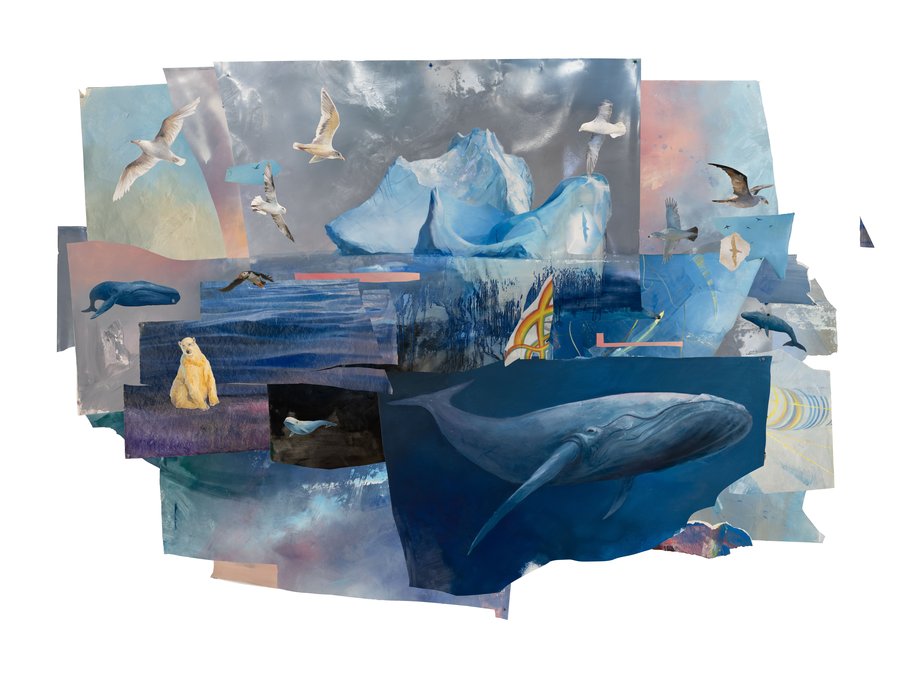
Phil Irish Companion Animals Oil on Paper, Collaged 76 x 112 in. (Credit: Ted Efremoff)
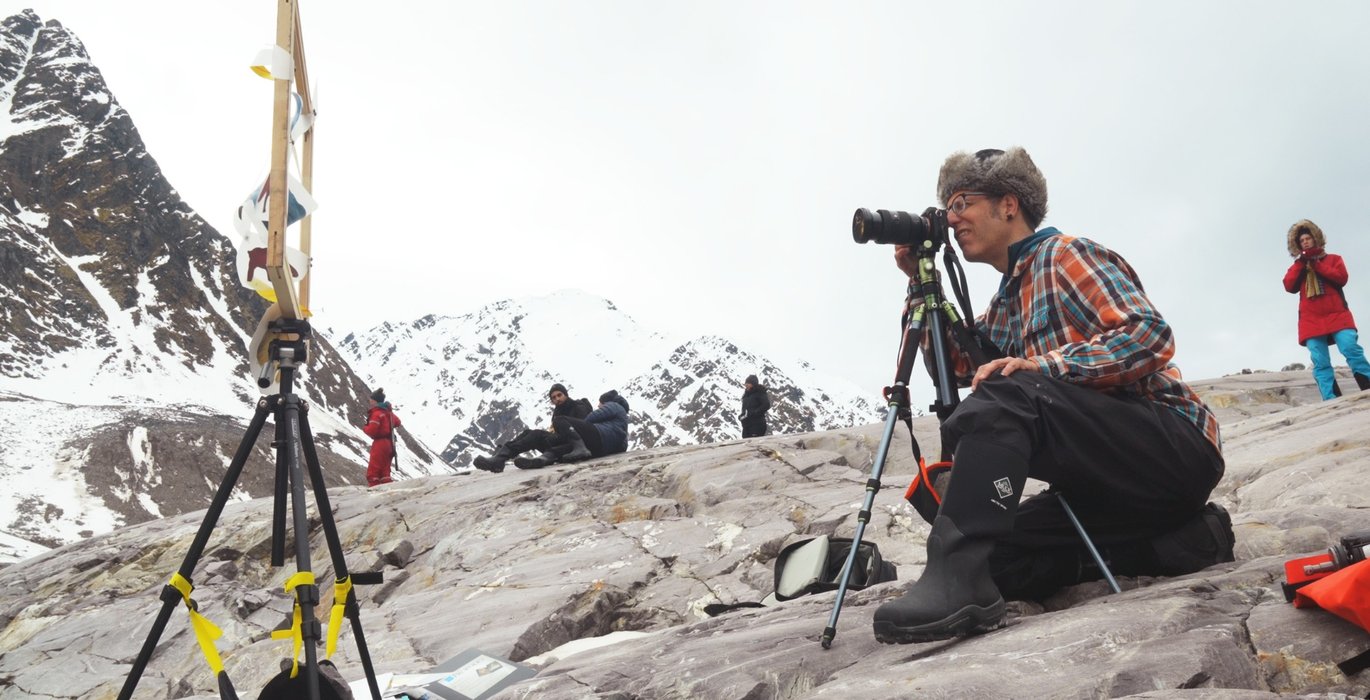
The exhibition drew on his experience from two expeditions: The Canada C3 expedition on Baffin Island, which brought together a diverse group of scientists, educators, Indigenous peoples, and artists; and the Arctic Circle residency in Norway’s Svalbard archipelago, which connected artists from around the world.
“They both took me to amazing places, surrounded by the discourse of inspiring people,” he said.
He learned a great deal from the people he met on his travels, particularly from his encounters with Inuit communities during the Canada C3 expedition, which he described as especially meaningful.
“Their stories were incredible,” he said. I got a greater sense of the complexity of modern Inuit lives.”
According to Irish, the Canada C3 conversations were more focused on topics such as justice for Inuit, social determinants of health, and history with the RCMP. In contrast, the Svalbard conversations were very focused on climate change in the Arctic and a rich dive into possible cultural responses.
The exhibition’s centrepiece, a large-scale sculptural installation titled Monument, he explained, “was made in direct response to Canada C3”. Paired with an original soundscape of whale calls and glacier calving, together, they challenge viewers to reconsider the Arctic not as a distant wilderness, but as a region closely connected to global environmental change.
“I want it to be seen that our civilizations are completely connected to the changes in the Arctic, and that the Arctic is not remote: our fates are intertwined.”
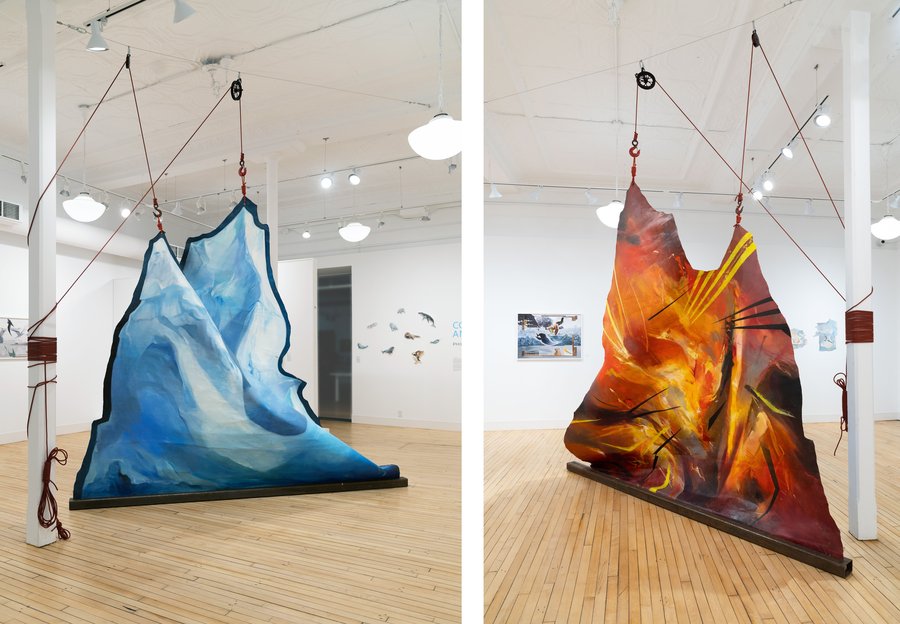
Monument, a large-scale sculptural installation paired with an original soundscape of whale calls and glacier calving. (Credit: Ted Efremoff)
At the core of Irish’s art is a resistance to treating photographs as an endpoint, but reference points that help reconstruct what a place felt like.
“My process is driven by the limitation of the photograph,” Irish said. “While my camera captures essential data, it lacks the visceral presence of a location.”
For Irish, painting becomes a way to bridge the gap between the recorded image and lived experience.
That thinking has shaped how he works in the field. During the Canada C3 expedition along Baffin Island, he set aside photography in favour of drawing, filling an Arctic logbook with sketches and watercolours.
“I quickly realized that other people had better cameras than me, and my time was better spent sketching,” he said.
A similar shift occurred during his Arctic Circle residency in Svalbard, where working within the constraints of ship life pushed him to produce work on site. The experience informed Niche Species, a project that combined photography with concerns about Arctic wildlife and environmental pressure.
“I wanted my pieces to be full of life, and also [address] the risk to that life,” he said.
While photography plays a reduced role in his current practice, its influence remains present. Animals continue to appear as recurring subjects, including in Companion Animals, where images are cut apart and reassembled into layered collages.
“I distill information from multiple images, infusing them with painterly invention to translate a visual record into a physical, embodied experience.”
He sees his shift toward collage and breaking the rectangular frame as a natural progression of his long-standing interest in multi-panel works.
“I’ve always been drawn to the structural logic of altarpieces and the narrative complexity of artists like Max Beckmann.”
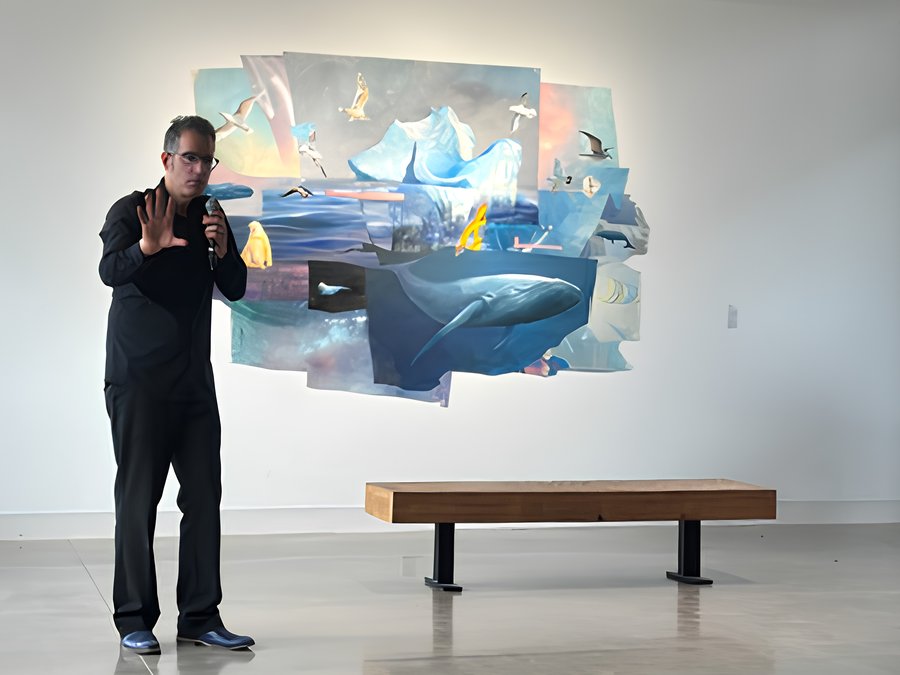
Phil Irish speaking during his exhibition at the Elora Center for Arts. (Credit: Melody Wren)
By deconstructing the image, he aims to mirror how we interpret contemporary reality through fragmented sources.
“Much like David Hockney’s critique of the camera as a ‘paralyzed cyclops,’ I believe that by layering and dismantling these perspectives, I can introduce a sense of movement and time, inviting the viewer to participate in the act of assembly.”
When discussing sound as an emotional catalyst, particularly in the integration of sculpture, performance, and sound in Monument, Irish reflected on the clinical nature of gallery spaces.
“Viewers often approach visual art analytically, whereas the darkness of a theatre allows for deeper emotional engagement,” he said.
Collaborating with multi-instrumentalist and producer Nathan Stretch allowed Irish to extend that work beyond the visual. The soundscape added urgency and a physical presence that could not be achieved through static forms alone.
“He translated the ‘field’ elements with wind, whale calls, and cracking ice, not through mere recordings, but through guitar, voice, and distortion pedals.”
When considering how his practice moves between field observation and studio-based reinterpretation, he emphasized the importance of balance.
“Being out in the world, feeling the moisture, the wind, and the rhythm of the waves is essential. It prevents the work from becoming purely academic.”
Outside the studio, Irish is grounded by family life and his Christian faith, which “holds a space of empathy and connection.” Time with his wife, poet Anna Mark, along with cooking and canoe trips, provides balance and reflection.
As for future Arctic projects, he stated there are “many images I haven’t managed to get out of my system,” suggesting further Arctic-based work may be ahead.