December 24, 2025
Researchers are uncovering new insights into human migration from an unusual place — the genetic and cultural history of Qimmit, or Greenlandic sled dogs. Working with modern mushers, museums, and ancient remains, a recent study in Science provides a glimpse into thousands of years of canine and human history.
“Dogs provide us with the excellent opportunity of tracing human migrations, in that you don’t just spontaneously have a dog. A dog has come with a person, and so they can reflect that element where a human has been,” said Tatiana Feuerborn, postdoctoral fellow at the National Human Genome Research Institute (NHGRI) for the National Institutes of Health (NIH) in Maryland. “We’re able to trace some human migrations through the different relationships of different dog populations."
An archaeologist by training, Feuerborn and her colleagues recently published their study on Greenlandic sled dogs’ genomes in Science.
“I’m really interested in the intertwined histories of dogs and humans, particularly in the Arctic, because dogs have been such a vital tool for human evolution,” Feuerborn said.

Dogs provide us with the excellent opportunity of tracing human migrations, in that you don’t just spontaneously have a dog. A dog has come with a person, and so they can reflect that element where a human has been. Credit: Tatiana Feuerborn)
Sled dogs have been intricately intertwined with Arctic life for at least 9,500 years. While many of those dogs have intermixed with other breeds over the years and even become domestic pets, the Greenlandic Qimmit (plural; one dog is a Qimmeq) have been uniquely preserved as working sled dogs, and remain closely intertwined with the culture and way of life.
Several regulations are in place to prevent these dogs from interbreeding with other dogs and from spreading epidemic illness. In Greenland, there is a sled dog district where Qimmit are the only dogs allowed. Exceptions are made if someone receives special permission to bring in a different type of dog for a specific purpose, such as sniffing explosives at an airport.
Using living dogs and museum specimens with enough DNA preserved in their bones to conduct testing, Feuerborn and colleagues sequenced the genomes of 92 different Qimmit representing three time periods: pre-European contact, post-contact, and the present day. Modern-day samples were collected with the help of mushers, who provided cheek swab saliva samples from their dogs. Researchers also compared their samples with 1,900 published dog genomes to learn about their history.
They found that Qimmit shared a clade — meaning they were believed to share a common ancestor — with certain other Arctic dogs, including a 3,700-year-old Alaskan sample.
"The ancient dog from Alaska was more closely related to the Greenland sled dogs that we had than it was to an Alaskan Malamute,” Feuerborn said, noting that “captures the close relationship that ancestors would have had to each other as the Greenland sled dogs’ ancestor travelled across the North American Arctic.”
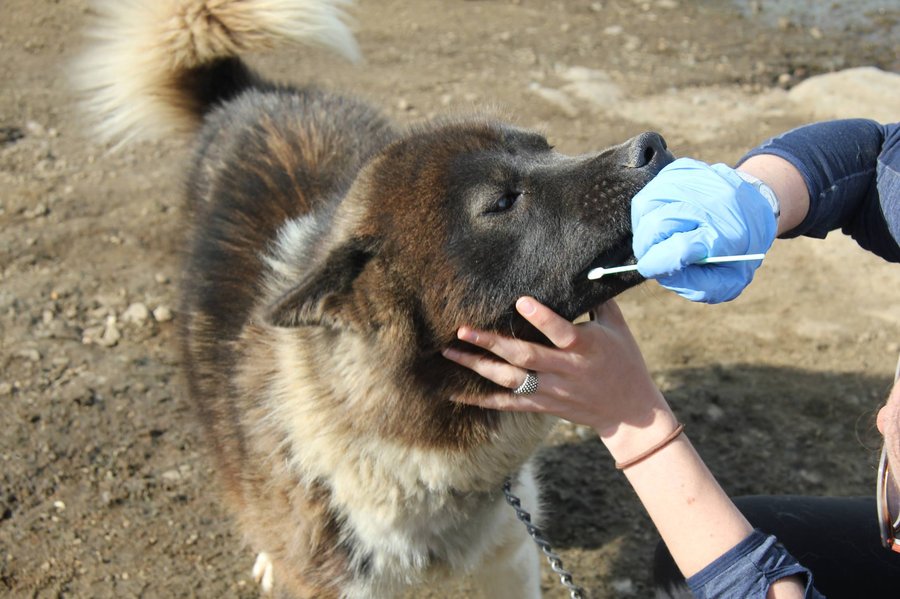
To learn about these animals, Feuerborn and colleagues sequenced the genomes of 92 different Qimmit. (Credit: Anne Mette Kroner)
Not only does this reveal the history of the dogs themselves, but it also leads researchers to new findings about human migration. The researchers wrote that their findings lend “support to the hypothesis that the Inuit settled the North American Arctic rapidly.”
The researchers found evidence of two migration periods, suggesting when people and their dogs may have arrived in the region. The authors wrote that “the distribution of European ancestry in humans and dogs mirrors each other.”
The dogs wouldn’t move on their own, so researchers believe this is related to a human migration across the North American Arctic. They found evidence showing that there were two different Inuit migrations from Canada into Greenland. They also found little European ancestry in today’s Qimmit. She stated that archaeological reports suggest a pioneer phase with a smaller group migrating into Greenland, followed by a later, larger settlement.
Feuerborn said that they “could see geographical separations in the human genomes based on where the humans were residing, and we could see the exact same splits in the dog population.”
She added that they were expecting to find dogs that shared genetics with wolves and had fairly recent hybridization, but that is not what they found. They found, in general, Arctic dogs contained more wolf than dogs from other regions, but there wasn’t much wolf in the Greenlandic dogs. They note that this could potentially be due to the small sample size of the study, especially since there are currently few wolves in Greenland, rather than an absence of these events.
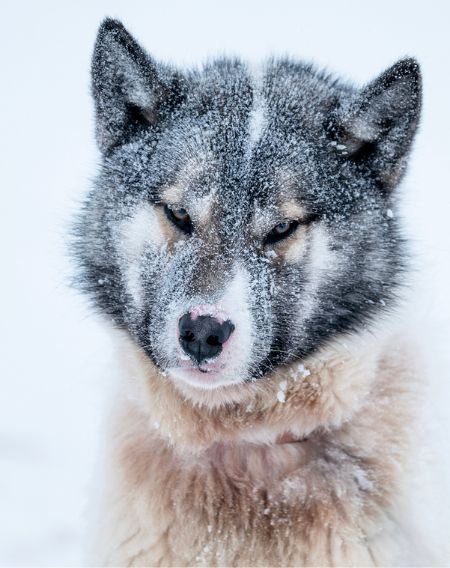
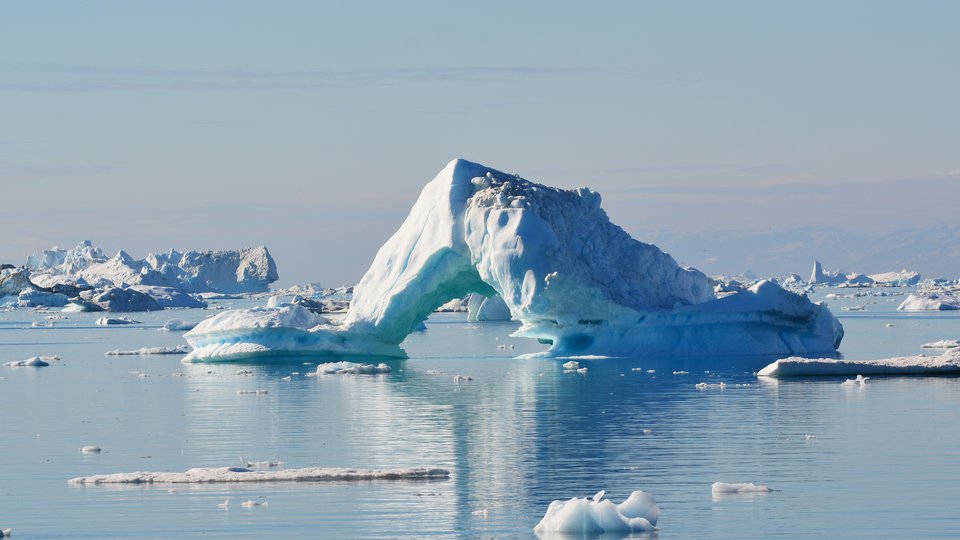
They found, in general, Arctic dogs contained more wolf than dogs from other regions, but there wasn’t much wolf in the Greenlandic dogs.(Credit: Carsten Egevang)
Today, Qimmit populations are declining rapidly, from 25,000 dogs in 2002 to only around 13,000 in 2020. The threats that Qimmit are facing include climate change, resulting in less sea ice and snow, increasing urbanization, and snowmobiles taking over roles that dogs would previously hold.
“Dogs are competing against reduced sea ice, snowmobiles, and urbanization as people are moving out of the smaller settlements where dog sledding is still practiced as a means of subsistence as well as a hobby,” Feuerborn said. “More people are moving to different countries or different cities, so the number of people using sled dogs is decreasing.”
She also pointed to the changing use of dogs, noting that previously, dogs were used for subsistence hunting to gather food for humans and themselves, but now more dogs are used for tourism and by hobbyists. She also highlighted the dog races that now occur yearly, and how that might impact populations.
“The dogs are now competing for speed, which is not historically an important factor, so it will be interesting to see if we can see changes over time in the dogs now that, instead of being used for endurance over great expanses of time and space and pulling heavy loads, but rather for speed.”
While researchers work to learn more about Qimmit by documenting the dogs’ genetics and genetic diversity, they find it especially vital to gather this information to help inform management and conservation. At the same time, these findings also reveal fascinating insight into the longstanding relationship between humans and dogs, and how canine genetics can teach us about their human companions.
Banner image credit: Carsten Egevang.